Jet Engines Market to Reach USD 99.84 Billion by 2030 as Aviation Industry Accelerates Toward Efficiency and Sustainability
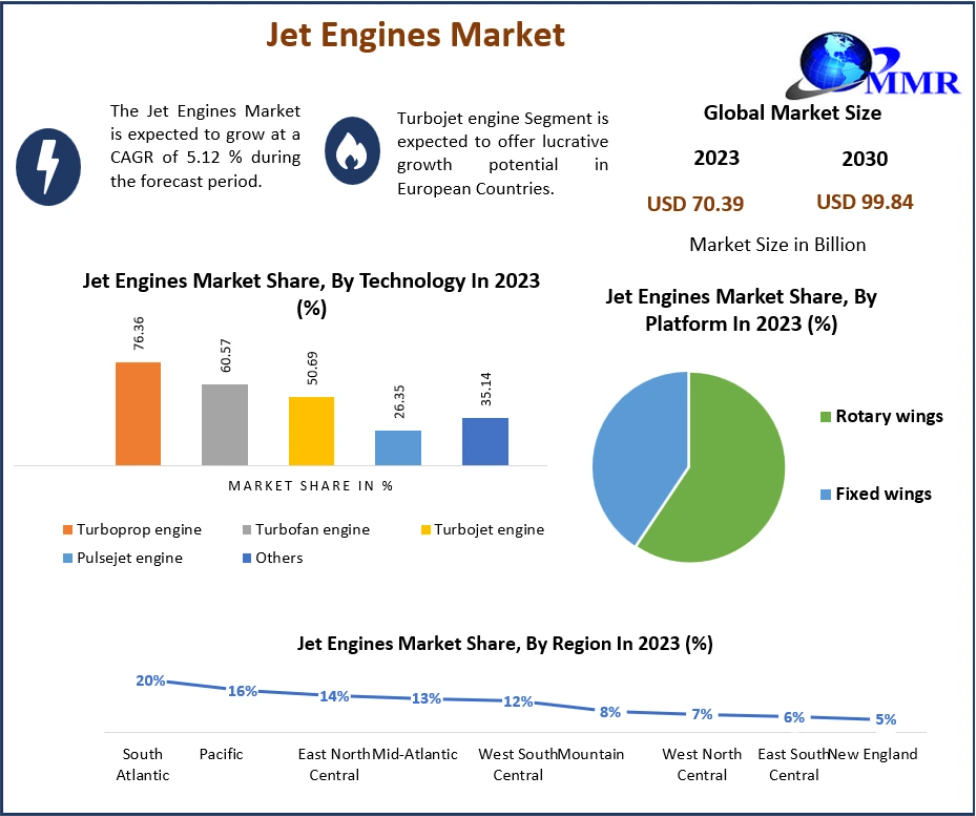
The Jet Engines Market is entering a transformative growth phase, fueled by rising global air travel, expanding airline fleets, and rapid advancements in propulsion technology. Valued at USD 70.39 billion in 2023, the market is projected to grow at a CAGR of 5.12%, reaching nearly USD 99.84 billion by 2030.
As the aviation industry evolves, jet engines are becoming more efficient, environmentally friendly, and technologically advanced—reshaping the future of air transportation.
What Are Jet Engines?
Jet engines are propulsion systems that generate thrust by expelling high-speed exhaust gases. These engines power a wide range of aircraft, including:
- Commercial airliners
- Military fighter jets
- Cargo aircraft
- Business jets
Common types of jet engines include turbofan, turboprop, turbojet, and ramjet engines, each designed for specific performance requirements.
To know about the Research Methodology :-https://www.maximizemarketresearch.com/request-sample/76380/
Key Market Drivers
✈️ Surge in Global Air Passenger Traffic
The rapid increase in air travel demand is a major growth driver. According to industry projections, thousands of new aircraft will be required in the coming decades, significantly boosting demand for advanced jet engines.
🌏 Expansion of Airline Fleets in Emerging Economies
Countries like China and India are investing heavily in aviation infrastructure and fleet expansion, creating strong demand for new engines and maintenance services.
⚙️ Technological Advancements in Engine Design
Leading manufacturers such as General Electric Aviation, Rolls-Royce Holdings, Pratt & Whitney, and CFM International are driving innovation with next-generation engines like:
- GE9X for high efficiency and power
- UltraFan for reduced emissions
- PW1000G geared turbofan for fuel savings
- LEAP engines for single-aisle aircraft
🌱 Shift Toward Sustainable Aviation
Stringent environmental regulations are pushing manufacturers to develop fuel-efficient and low-emission engines, including hybrid-electric and hydrogen-powered solutions.
Market Challenges
💸 High Development and R&D Costs
Developing advanced jet engines requires significant investment in engineering, testing, and infrastructure, making it a capital-intensive industry.
🌍 Stringent Emission Regulations
Organizations such as the International Civil Aviation Organization are enforcing strict carbon reduction targets, increasing pressure on manufacturers.
🔗 Supply Chain Disruptions
Global supply chain vulnerabilities and geopolitical tensions continue to impact production timelines and costs.
Segment Insights
🛩️ By Technology
- Turbofan engines dominate commercial aviation due to their balance of efficiency and thrust
- Turboprop engines lead in regional and short-haul flights
- Turbojet engines are primarily used in military aircraft
- Pulsejet engines serve niche applications like UAVs
🎯 By Application
- Commercial aviation holds the largest share due to extensive global airline fleets
- Military aviation demands high-performance engines for advanced fighter jets
- Business aviation focuses on efficiency and long-range performance
To know about the Research Methodology :-https://www.maximizemarketresearch.com/request-sample/76380/
Regional Insights
🇺🇸 North America Leads the Market
North America dominates the jet engines market, driven by strong demand in both commercial and defense aviation sectors. The United States remains a global hub for engine manufacturing and innovation.
🇪🇺 Europe Focuses on Sustainability
Countries like the UK, France, and Germany are investing heavily in eco-friendly engine technologies, supported by major players such as Safran Aircraft Engines and MTU Aero Engines.
🌏 Asia-Pacific Shows Fastest Growth
Rapid urbanization and increasing air travel demand in countries like China, India, Japan, and South Korea are driving significant market expansion.
🌍 Emerging Regions Gain Momentum
The Middle East, Latin America, and Africa are witnessing steady growth due to rising airline hubs, infrastructure investments, and fleet modernization.
Competitive Landscape
The global jet engines market is highly competitive, with key players focusing on innovation, partnerships, and sustainability initiatives. Major companies include:
- General Electric Aviation
- Rolls-Royce Holdings
- Pratt & Whitney
- CFM International
- Honeywell Aerospace
- Safran Aircraft Engines
- MTU Aero Engines
These companies are shaping the future of aviation propulsion through continuous innovation and strategic collaborations.
Future Outlook
The Jet Engines Market is poised for steady growth as the aviation industry transitions toward greener and more efficient technologies. Key trends include:
- Development of hydrogen-powered engines
- Adoption of hybrid-electric propulsion systems
- Increasing focus on noise reduction and fuel efficiency
- Integration of advanced materials and digital technologies
Conclusion
The global jet engines market is evolving rapidly, driven by technological innovation, environmental concerns, and growing air travel demand. As manufacturers push the boundaries of efficiency and sustainability, the next generation of jet engines will play a crucial role in shaping the future of aviation.
With strong growth prospects and ongoing advancements, the industry is set to remain a cornerstone of the global aerospace sector through 2030 and beyond.