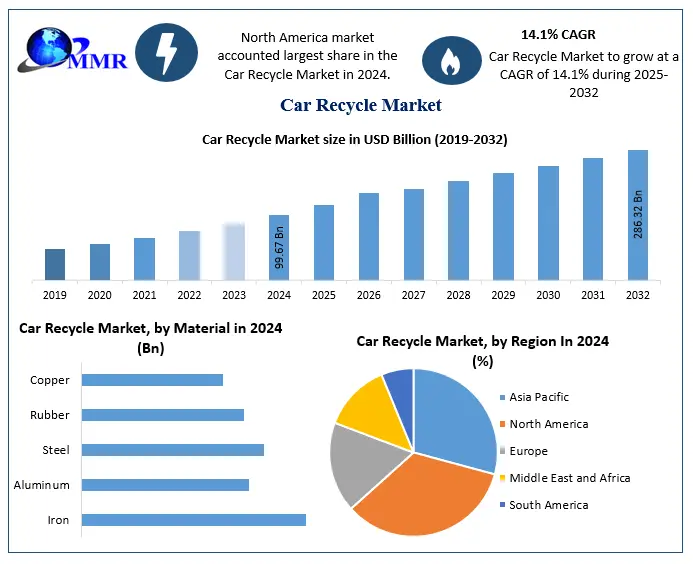
The global Car Recycle Market is entering a high-growth phase, driven by sustainability mandates, rising end-of-life vehicles (ELVs), and increasing demand for secondary raw materials. The market was valued at USD 99.67 billion in 2024 and is projected to expand at a CAGR of 14.1%, reaching approximately USD 286.32 billion by 2032.
Market Overview
Car recycling involves dismantling end-of-life vehicles and recovering usable components and materials such as metals, plastics, rubber, and glass. The process typically includes four key stages:
- Dismantling – Removal of reusable components (engines, batteries, tires, electronics)
- Crushing – Compacting vehicle bodies
- Shredding – Breaking down materials into smaller fragments
- Material Recovery – Separation and purification of metals and other materials
Advanced technologies like eddy current separation, infrared sorting, and laser-based systems are increasingly used to improve recovery efficiency.
With vehicle recycling rates reaching nearly 80% globally, automobiles are among the most recycled consumer products, making this market highly attractive.
To know the most attractive segments, click here for a free sample of the report:https://www.maximizemarketresearch.com/request-sample/52805/
Market Dynamics
Key Growth Drivers
- Strong Regulatory Support
Governments worldwide are enforcing strict environmental regulations to reduce landfill waste and carbon emissions. Organizations such as the Automotive Recyclers Association and the U.S. Environmental Protection Agency are promoting sustainable recycling practices and compliance standards. - Rising Demand for Recycled Materials
High import duties on virgin metals and fluctuating raw material prices are encouraging automakers to use recycled steel and aluminum, boosting demand for recycled inputs. - Surge in End-of-Life Vehicles (ELVs)
More than 27 million vehicles reach end-of-life annually. Aging vehicle fleets and increased accident rates are significantly contributing to recycling volumes. - Environmental Awareness and Sustainability Goals
Consumers and manufacturers are prioritizing eco-friendly practices, including reducing greenhouse gas emissions and minimizing hazardous waste. - Technological Advancements
Modern recycling facilities are adopting automation and AI-driven sorting technologies to improve material recovery rates and operational efficiency.
Market Challenges
- Complex Material Composition: Modern vehicles use over 30 types of plastics and polymers, making separation costly and technically challenging.
- High Processing Costs: Advanced recycling technologies require significant capital investment.
- Low Recycling Rates in Emerging Markets: Infrastructure gaps and lack of awareness hinder adoption in developing regions.
Market Segmentation
By Material
- Metals (Steel, Iron, Aluminum) – Dominates the market due to high recyclability and strong demand
- Rubber – Expected to grow significantly due to tire recycling applications
- Plastic – Emerging segment with increasing focus on sustainable reuse
- Copper, Glass, Others – Niche but essential components in recycling streams
Steel remains the most recycled material, with over 18 million tons recovered annually from ELVs.
By Type
- Passenger Cars Recycling
This segment leads the market and is expected to grow at the fastest rate due to stricter vehicle scrappage policies and higher passenger vehicle ownership. - Commercial Vehicles Recycling
Driven by fleet modernization and industrial vehicle turnover.
To know the most attractive segments, click here for a free sample of the report:https://www.maximizemarketresearch.com/request-sample/52805/
Regional Insights
North America – Market Leader
North America dominates the global market, particularly the United States, due to:
- High vehicle recycling rates
- Mature recycling infrastructure
- Strong regulatory framework
- Employment of over 100,000 workers in the recycling industry
Asia-Pacific – Fastest Growing Region
Asia-Pacific is witnessing rapid growth due to:
- Increasing vehicle production and ownership
- Government initiatives promoting circular economy models
- Rising environmental awareness
However, recycling rates are still developing compared to Western markets, presenting significant growth opportunities.
Competitive Landscape
The market is highly fragmented, with key players focusing on expansion, partnerships, and technology adoption to strengthen their positions. Major companies include:
- Schnitzer Steel Industries, Inc.
- Sims Metal Management Limited
- LKQ Corporation
- Toyota Motor Corporation
- European Metal Recycling
- Eco-Bat Technologies Ltd
These companies are investing in advanced recycling technologies, expanding global operations, and integrating circular economy practices.
Future Outlook
The car recycle market is poised for substantial growth over the next decade, supported by:
- Expansion of electric vehicle (EV) recycling ecosystems
- Increasing focus on circular economy and resource efficiency
- Technological innovation in material recovery
- Government-backed vehicle scrappage policies
As sustainability becomes a central pillar of the automotive industry, car recycling will play a critical role in reducing environmental impact and ensuring efficient resource utilization.
Conclusion
The global car recycle market is transforming rapidly, driven by environmental regulations, technological advancements, and growing volumes of end-of-life vehicles. With strong growth projections and increasing global awareness, the market offers significant opportunities for recyclers, automakers, and investors aiming to capitalize on the circular economy.