Freight Forwarding Market Overview
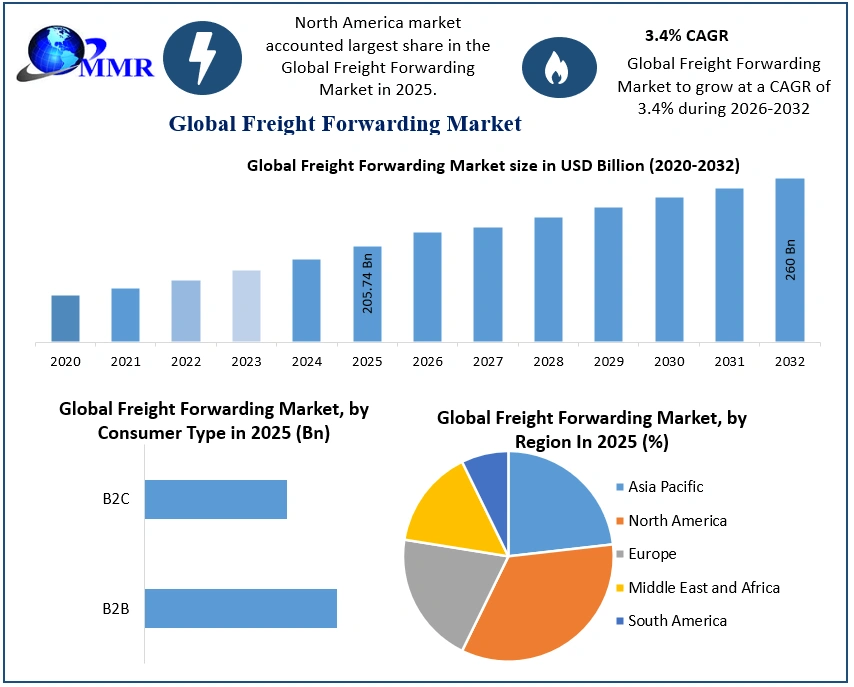
The Freight Forwarding Market was valued at USD 205.74 billion in 2025 and is expected to grow at a CAGR of 3.4% from 2025 to 2032, reaching approximately USD 260 billion by 2032.
Freight forwarding refers to the strategic coordination and transportation of goods across international borders using multiple modes such as air, sea, rail, and road. It plays a critical role in global trade by ensuring efficient, cost-effective, and timely delivery of goods. Freight forwarders manage key logistics functions, including customs clearance, freight rate negotiation, cargo tracking, and documentation.
As global supply chains become increasingly complex, the demand for advanced logistics solutions and integrated freight services continues to rise.
To know about the Research Methodology :https://www.maximizemarketresearch.com/request-sample/148362/
Market Dynamics
Key Growth Drivers
- Expansion of Global Trade Agreements
International trade agreements are significantly boosting cross-border trade activities. One prominent example is the Regional Comprehensive Economic Partnership, which connects 15 Asia-Pacific economies and facilitates tariff reductions. Such agreements increase import-export volumes, directly driving demand for freight forwarding services.
- Integration of Artificial Intelligence (AI)
The adoption of AI in logistics is transforming freight forwarding operations. AI-powered platforms enhance:
- Route optimization
- Cost efficiency
- Real-time shipment tracking
- Demand forecasting
For instance, Kuehne + Nagel International AG introduced an AI-enabled platform to streamline overland freight services, enabling customers to compare and select cost-effective shipping solutions.
- Growth in Air and Ocean Freight
The rise in international trade, particularly in pharmaceuticals and cross-border e-commerce, is driving both air and ocean freight segments. Ocean freight remains dominant due to its cost efficiency for bulk shipments, while air freight is gaining traction for time-sensitive goods.
- Surge in E-commerce Logistics
The rapid expansion of e-commerce has significantly increased demand for freight forwarding services. Online retail growth has led to higher cargo volumes, particularly in air freight, where fast delivery is essential.
Market Challenges
Impact of Nearshoring and Reshoring
The trend toward nearshoring and reshoring manufacturing operations may reduce long-distance trade volumes, posing a challenge to freight forwarders. Companies are increasingly relocating production closer to end markets to minimize supply chain risks.
However, despite these challenges, the continued growth of global trade and e-commerce is expected to sustain demand for freight forwarding services.
Market Segmentation
By Mode of Transport
- Ocean Freight: Dominates the market with the largest share due to cost advantages
- Air Freight: Preferred for high-value and time-sensitive goods
- Rail Freight
- Road Freight
Ocean freight continues to lead, supported by infrastructure developments such as new ports and container capacity expansion.
By Application
- Industrial & Manufacturing
- Retail
- Healthcare
- Oil & Gas
- Food & Beverages
- Military
- Others
The automotive sector remains a major contributor, with countries like Germany and Japan leading global vehicle exports.
By Customer Type
- B2B
- B2C
By Service
- Transportation & Warehousing
- Packaging & Documentation
- Insurance
- Value-Added Services
To know about the Research Methodology :https://www.maximizemarketresearch.com/request-sample/148362/
Regional Insights
North America Leads the Market
North America held the largest share in 2025, driven by strong trade activity and a well-established logistics infrastructure. The United States plays a key role due to its extensive network of trading partners and high import-export volumes.
Asia Pacific Emerges as Fastest-Growing Region
Asia Pacific is expected to witness the fastest growth, supported by:
- Rapid industrialization
- Expanding e-commerce sector
- Strong government support for logistics infrastructure
Countries such as China and India are key contributors to regional growth.
Competitive Landscape
The freight forwarding market is highly competitive, with companies focusing on digital transformation, mergers, and global expansion. Leading players include:
- DHL Global Forwarding
- DB Schenker
- CEVA Logistics
- Bolloré Logistics
- DSV Panalpina
- Expeditors International
- Nippon Express
- UPS Supply Chain Solutions
Strategic acquisitions are shaping the competitive landscape. For example, Kuehne + Nagel acquired Apex International to strengthen its presence in Asia.
Conclusion
The global Freight Forwarding Market is set for steady growth, driven by increasing international trade, technological advancements, and the expansion of e-commerce. While challenges such as nearshoring trends persist, innovations in AI and digital logistics platforms are reshaping the industry.
As supply chains become more interconnected and complex, freight forwarders will continue to play a vital role in enabling seamless global trade and ensuring efficient movement of goods.