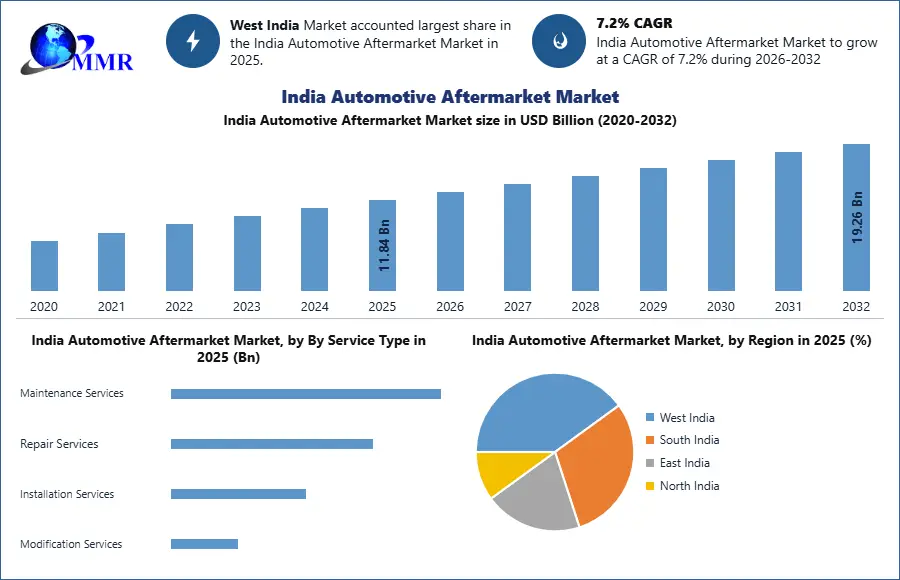
The India Automotive Aftermarket was valued at USD 11.84 billion in 2025 and is projected to reach approximately USD 19.26 billion by 2032, growing at a CAGR of 7.2%. The market is undergoing a significant transformation, driven by rising vehicle ownership, digital disruption, and evolving consumer preferences.
Market Overview
India’s automotive aftermarket is witnessing robust growth, supported by a rapidly expanding vehicle parc, which has already crossed 340 million vehicles. With continuous growth expected in both two-wheelers and passenger vehicles, the demand for maintenance, repair, and replacement services is rising steadily.
The surge in pre-owned vehicle sales and increasing vehicle lifespan are further amplifying aftermarket demand, making India one of the most promising global markets for automotive services and components.
Get Full PDF Sample Copy of Report:https://www.maximizemarketresearch.com/request-sample/29939/
Key Growth Drivers
Rising Vehicle Ownership and Usage
The growth in vehicle sales across segments—especially two-wheelers and passenger cars—has significantly boosted aftermarket demand. Increased usage leads to higher wear and tear, driving consistent demand for servicing and replacement parts.
Booming Pre-Owned Vehicle Market
India’s used car market is expanding rapidly, expected to grow at a strong pace through 2030. Organized players and digital platforms are enhancing transparency and accessibility, leading to increased demand for refurbishment, servicing, and parts replacement.
Shift Toward Digital and E-Commerce Channels
The aftermarket ecosystem is evolving from traditional distribution models to digital-first platforms. Collaborations between OEMs and platforms like Amazon and eBay are streamlining direct-to-consumer sales and improving product accessibility.
Export Opportunities
Indian aftermarket manufacturers are increasingly targeting global markets such as Brazil, Poland, and Bangladesh, along with emerging regions in Africa and the Middle East. This global outlook is opening new revenue streams for domestic players.
Emerging Market Trends
Transition in Business Models
The industry is shifting from traditional wholesale distribution to integrated digital ecosystems. OEMs are increasingly partnering with online platforms to reach customers directly, improving margins and customer engagement.
Rise of Predictive Maintenance
Connected vehicles and IoT-enabled systems are transforming aftermarket services. Real-time data allows for predictive diagnostics, enabling service providers to identify issues before breakdowns occur.
Declining Dependency on Traditional Parts
Improved durability of automotive components and enhanced safety features are reducing demand for certain wear-and-tear and crash-related parts. Growth is now shifting toward software-driven services and advanced diagnostics.
Market Restraints
Stringent Regulatory Framework
The Indian aftermarket is subject to strict compliance with safety and quality standards such as BIS and AIS certifications. These regulations:
- Increase operational and compliance costs
- Create entry barriers for small players
- Limit flexibility in product innovation
While necessary for safety and environmental protection, these regulations can slow down market expansion.
Growth Opportunities
Technological Advancements
The rise of electric vehicles (EVs), connected mobility, and advanced driver assistance systems (ADAS) is creating new opportunities for aftermarket players. Services such as:
- Battery management and EV servicing
- Software updates and diagnostics
- ADAS calibration and retrofitting
are expected to become key revenue drivers.
Customization and Performance Upgrades
Advancements in manufacturing technologies, including 3D printing, are enabling personalized automotive components, opening niche but high-value opportunities.
Segment Insights
By Service Type
- Maintenance Services dominate the market, driven by regular servicing needs.
- Repair Services follow closely due to increasing vehicle usage and accident-related repairs.
- Installation Services are growing with rising adoption of advanced components.
- Modification Services are gaining popularity among younger consumers and enthusiasts.
By Replacement Parts
The replacement parts segment leads the market, with high demand for:
- Batteries
- Tires and wheels
- Lubricants and fluids
Other key components include brake systems, filters, lighting, and suspension parts, driven by safety awareness and regulatory requirements.
By Vehicle Type
- Passenger Cars hold the largest market share due to rising ownership.
- Motorcycles contribute significantly due to their large base and frequent servicing needs.
- Commercial and heavy-duty vehicles generate consistent demand for high-value components.
Regional Insights
- Western India leads the market, supported by industrialization and strong distribution networks.
- Southern India is witnessing rapid growth due to urbanization and IT-driven economic expansion.
- Northern India maintains steady demand driven by population density and logistics activity.
- Eastern India is an emerging market with increasing automotive penetration.
Get Full PDF Sample Copy of Report:https://www.maximizemarketresearch.com/request-sample/29939/
Competitive Landscape
The India automotive aftermarket is highly competitive, with a mix of domestic and global players focusing on innovation, distribution expansion, and digital integration. Key companies include:
- Bosch India
- TVS Group
- Tata Motors
- Mahindra & Mahindra
- Exide Industries
- Amara Raja Batteries
- Hero MotoCorp
- MRF Limited
- Apollo Tyres
These players are investing in digital platforms, expanding service networks, and focusing on high-quality certified parts to strengthen their market position.
Conclusion
The India automotive aftermarket is entering a high-growth phase, driven by rising vehicle ownership, digital transformation, and evolving mobility trends. While regulatory challenges and market fragmentation persist, the increasing adoption of connected technologies and EVs is expected to reshape the industry landscape.
With strong domestic demand and growing export potential, the sector is well-positioned to become a key pillar of India’s automotive ecosystem in the coming years.