Climbing Gears Market Overview
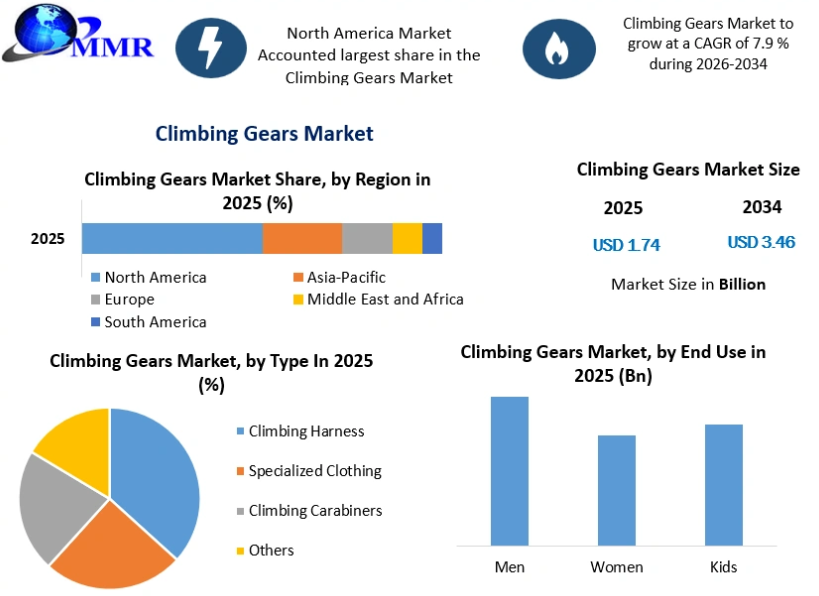
The Global Climbing Gears Market was valued at USD 1.74 billion in 2025 and is projected to reach nearly USD 3.46 billion by 2034, growing at a CAGR of 7.9% during the forecast period from 2026 to 2034. Market growth is primarily driven by the increasing popularity of adventure sports, expanding indoor climbing facilities, rising participation in mountaineering and rock climbing, and growing consumer awareness of personal safety equipment.
Feel free to request a complimentary sample copy or view a summary of the report: https://www.maximizemarketresearch.com/request-sample/186965/
Climbing gears include specialized equipment and accessories designed to support climbers during indoor climbing, outdoor rock climbing, mountaineering, ice climbing, and other adventure activities. Essential products include climbing harnesses, carabiners, ropes, helmets, belay devices, specialized clothing, and protective accessories. Technological advancements in materials and manufacturing are encouraging the development of lightweight, durable, and high-performance products that improve comfort and safety.
The increasing integration of climbing activities into recreational tourism and fitness programs is creating new opportunities for manufacturers, distributors, and adventure tourism operators. Online retail platforms have also improved access to climbing equipment by providing extensive product selections, customer reviews, and convenient purchasing options. These factors are expected to support the expansion of the Climbing Gears Market throughout the forecast period.
Climbing Gears Market Drivers and Trends
Growing Popularity of Adventure Sports and Outdoor Recreation
The rising popularity of adventure tourism is one of the major factors driving the Climbing Gears Market. Rock climbing, bouldering, mountaineering, ice climbing, and sport climbing are attracting recreational participants as well as experienced athletes. Consumers increasingly seek outdoor experiences that combine physical fitness, personal achievement, and adventure.
Adventure tourism operators and climbing schools are expanding their service offerings to accommodate this growing interest. As participation increases, demand for reliable climbing harnesses, ropes, helmets, carabiners, and belay devices is expected to rise. Equipment manufacturers are responding by introducing products designed for different experience levels, environmental conditions, and climbing disciplines.
Technological Advancements in Climbing Equipment
Product innovation is transforming the competitive landscape of the Climbing Gears Market. Manufacturers are investing in advanced materials, ergonomic designs, improved load distribution, and equipment that combines strength with reduced weight. Lightweight alloys, durable synthetic fibers, and specialized textiles are increasingly important in the development of modern climbing equipment.
Feel free to request a complimentary sample copy or view a summary of the report: https://www.maximizemarketresearch.com/request-sample/186965/
These innovations help climbers reduce equipment weight during long expeditions while maintaining essential performance and safety characteristics. Improvements in assisted-braking belay devices, harness adjustment systems, and equipment ergonomics are also enhancing usability. Continued product development is expected to create opportunities for established manufacturers and emerging companies offering specialized climbing solutions.
Expansion of Indoor Climbing Gyms and Fitness Facilities
Indoor climbing gyms have become important entry points for beginners and recreational athletes. These facilities provide controlled environments for learning climbing techniques, improving strength, and developing endurance without requiring immediate access to natural climbing locations.
The expansion of commercial climbing gyms, training centers, and recreational sports facilities is creating recurring demand for climbing equipment. Facility operators require harnesses, ropes, carabiners, belay devices, and other products for training programs and customer activities. Regular equipment inspection and replacement also contribute to demand.
Furthermore, climbing is increasingly recognized as an activity that combines cardiovascular exercise, muscular strength, balance, and coordination. This broader fitness appeal is expected to encourage participation among younger consumers, families, and individuals seeking alternative forms of exercise.
Increasing Focus on Safety and Equipment Standards
Safety remains a central consideration in climbing equipment purchasing decisions. Climbers, professional guides, climbing schools, and commercial facility operators require equipment that meets applicable safety standards and performs reliably under demanding conditions.
Growing awareness of equipment inspection, appropriate product selection, and safe climbing practices is encouraging consumers to invest in quality products rather than relying exclusively on low-cost alternatives. Manufacturers that emphasize durability, product testing, traceability, and compliance with relevant standards can strengthen customer confidence and brand loyalty.
The adoption of safety-oriented product designs is expected to support demand for climbing harnesses, helmets, carabiners, ropes, and belay systems during the forecast period.
Growth of E-commerce and Specialty Retail Distribution
Online distribution is an important growth channel for the Climbing Gears Market. E-commerce platforms allow customers to compare product specifications, evaluate customer feedback, explore specialized equipment, and purchase products from domestic and international manufacturers.
Online channels are particularly useful for experienced climbers searching for specific equipment configurations and technical products that may not be available through general retail stores. Digital marketing and climbing communities also help brands reach consumers interested in new products and outdoor activities.
However, offline specialty retailers continue to play an important role by offering product demonstrations, fitting assistance, technical guidance, and opportunities to examine equipment before purchasing. The combination of online convenience and specialized in-store support is expected to shape future distribution strategies.
Key Market Segments Covered
The Climbing Gears Market is segmented by type, end use, distribution channel, and application. Each segment serves different consumer requirements, from recreational climbing to professional mountaineering and organized adventure sports.
By Type
Based on type, the market includes climbing harnesses, specialized clothing, climbing carabiners, and other equipment.
The climbing harness segment held the largest market share in 2025 and is expected to maintain a significant position during the forecast period. Harnesses are essential safety products that distribute forces across the body and connect climbers to ropes and belay systems. Demand is supported by their use in rock climbing, ice climbing, mountaineering, indoor climbing, and other rope-based activities.
Specialized climbing clothing represents another important segment. Products designed for climbing generally emphasize flexibility, abrasion resistance, breathability, and freedom of movement. Manufacturers are developing clothing suitable for different weather conditions and climbing environments.
Climbing carabiners are also essential components of climbing systems. Their applications include connecting ropes, harnesses, anchors, and other equipment. Other products include climbing ropes, helmets, belay devices, chalk bags, slings, and protective accessories. Product innovation and safety requirements are expected to support demand across these categories.
By End Use
Based on end use, the market is segmented into men, women, and kids.
The men’s segment represents an important consumer category because of its established participation across recreational and professional climbing activities. However, the increasing participation of women in outdoor recreation and indoor climbing is creating opportunities for manufacturers to develop more inclusive product ranges.
The women’s segment benefits from demand for equipment with appropriate fit, comfort, adjustability, and performance characteristics. Products designed around different body proportions and individual requirements can improve the user experience.
The kids’ segment is supported by the expansion of family-oriented recreation, youth climbing programs, and indoor climbing facilities. Specialized equipment for younger climbers must be selected according to appropriate sizing, intended use, and applicable safety requirements. Growth in organized youth activities may provide additional opportunities for manufacturers and retailers.
By Distribution Channel
Based on distribution channel, the market includes online and offline sales, with offline distribution covering supermarkets and hypermarkets, specialist retailers, and other outlets.
The online segment benefits from broad product availability, convenient ordering, competitive pricing, and access to product reviews. Digital platforms also enable manufacturers to communicate technical specifications and reach consumers in regions where specialist climbing stores are limited.
The offline segment remains important because climbing equipment requires careful product selection and, in some cases, professional fitting and technical guidance. Specialist retailers can help customers understand equipment compatibility, sizing, intended applications, and maintenance requirements.
Supermarkets, hypermarkets, and general sporting-goods retailers provide additional access to selected climbing products. Nevertheless, specialist retailers are particularly relevant for technical equipment purchased by experienced climbers and professional users.
By Application
The application segment includes cleaning, snowsports, watersports, adventure sports, hiking, and other activities.
Adventure sports represented the leading application segment in 2025, supported by demand for equipment used in rock climbing, bouldering, mountaineering, and organized climbing experiences. These activities require dependable equipment suited to specific climbing conditions and user requirements.
Snowsports and mountaineering applications create demand for specialized equipment designed for cold temperatures, ice, and challenging alpine environments. Hiking and related outdoor activities may also support demand for selected climbing accessories, particularly among consumers participating in multi-activity expeditions.
Certain climbing products are used in industrial access, maintenance, and other rope-access activities. However, equipment requirements differ according to application, and products must be selected according to the relevant safety standards and intended use.
Feel free to request a complimentary sample copy or view a summary of the report: https://www.maximizemarketresearch.com/request-sample/186965/
Climbing Gears Market Regional Insights
North America
North America held the largest share of the Climbing Gears Market in 2025. The region benefits from established outdoor recreation markets, a strong network of climbing destinations, developed sporting-goods distribution channels, and growing participation in indoor climbing.
The United States and Canada offer a variety of natural climbing environments, including mountain ranges, national parks, and established rock-climbing destinations. These locations attract recreational climbers, experienced mountaineers, and adventure tourists.
The expansion of climbing gyms and the availability of specialized equipment through online and offline retailers are also supporting market demand. Consumer interest in durable, lightweight, and technically advanced products is expected to create opportunities for established brands and specialized manufacturers.
Europe
Europe is expected to record the highest regional CAGR of 9.2% during the forecast period from 2026 to 2034, according to the supplied market estimates. The region benefits from established mountaineering traditions, extensive outdoor recreation infrastructure, and increasing interest in indoor climbing.
Countries such as Germany, France, Italy, Austria, Switzerland, and the United Kingdom provide important markets for climbing equipment. Alpine destinations and organized climbing facilities attract both local participants and international visitors.
Indoor climbing gyms are also contributing to market development by making climbing accessible to people who do not live near natural climbing locations. Demand for equipment designed for indoor training, sport climbing, and alpine expeditions is expected to support regional growth.
Asia Pacific
The Asia Pacific Climbing Gears Market is expected to benefit from rising disposable incomes, expanding urban recreation facilities, growing interest in adventure tourism, and increasing participation in fitness activities.
China, India, Japan, Australia, Indonesia, and other regional markets offer opportunities for manufacturers and distributors. The development of indoor climbing facilities and the promotion of outdoor sports are helping introduce climbing to new consumer groups.
India has additional potential because of its diverse natural landscapes and rock-climbing destinations, including locations in Maharashtra. Growing awareness of equipment quality and compliance with applicable standards may encourage demand for reliable products. Expanding e-commerce infrastructure is also improving access to specialized equipment across the region.
South America
South America offers opportunities for market growth through its mountains, rock formations, and emerging adventure tourism destinations. Brazil and Argentina are important markets for outdoor recreation, while climbing destinations attract domestic and international participants.
Brazil’s established climbing areas, including Milho Verde, contribute to the region’s appeal among rock-climbing enthusiasts. Tourism operators, climbing guides, and recreational facilities create demand for equipment suitable for different climbing conditions.
As adventure tourism infrastructure develops and awareness of climbing safety increases, demand for climbing harnesses, carabiners, ropes, helmets, and related accessories is expected to expand.
Middle East and Africa
The Middle East and Africa region presents opportunities associated with adventure tourism, mountain destinations, outdoor recreation, and the gradual development of specialized sports facilities.
Countries in the Gulf Cooperation Council, South Africa, Egypt, and other markets offer different climbing and outdoor recreation environments. Tourism investments and the development of guided outdoor experiences may support demand for climbing equipment.
However, market expansion will depend on the availability of specialist retailers, consumer awareness, access to trained guides, and the affordability of quality equipment. Partnerships with local distributors and tourism operators may help manufacturers increase regional penetration.
Major Industry Players and Competitive Landscape
The Climbing Gears Market is characterized by competition among established outdoor equipment manufacturers and specialized climbing brands. Companies compete through product innovation, material quality, safety performance, brand recognition, distribution partnerships, and expansion into new geographic markets.
Leading participants identified in the market include Ober Alp SPA, Metolius Climbing, EDELRID GmbH & Co. KG, Grivel S.r.l., SINGING ROCK s.r.o., Great Trango Holdings, Inc., Mammut Sports Group AG, Petzl Distribution, Kailas Sports Product Co. Ltd., Mad Rock Climbing, ANTA Sports Products Limited, DMM International Ltd., Omega Pacific, and Five Ten.
Petzl is known for climbing and rope-access equipment, including harnesses, headlamps, and belay devices. Mammut Sports Group offers climbing equipment and technical outdoor products, while EDELRID focuses on climbing and rope-based safety solutions. Grivel has a presence in mountaineering and alpine equipment, and DMM International manufactures technical climbing hardware.
Frequently Asked Questions
1. What was the global Climbing Gears Market size in 2025?
The global Climbing Gears Market was valued at USD 1.74 billion in 2025.
2. What is the expected size of the Climbing Gears Market by 2034?
The market is projected to reach nearly USD 3.46 billion by 2034.
3. What is the expected CAGR of the Climbing Gears Market during 2026–2034?
The Climbing Gears Market is expected to grow at a CAGR of 7.9% during the forecast period from 2026 to 2034.
4. Which region held the largest share of the Climbing Gears Market in 2025?
North America held the largest regional market share in 2025, supported by established outdoor recreation markets, climbing destinations, and specialized retail infrastructure.
5. Which region is expected to grow at the highest CAGR?
Europe is projected to record the highest regional CAGR of 9.2% during 2026–2034, according to the supplied market estimates.
Conclusion
The Climbing Gears Market is positioned for sustained growth as adventure sports, indoor climbing, and outdoor recreation gain popularity worldwide. The market’s projected increase from USD 1.74 billion in 2025 to USD 3.46 billion by 2034 reflects opportunities across equipment manufacturing, specialist retail, e-commerce, and adventure tourism.
Manufacturers that prioritize product reliability, appropriate safety standards, user comfort, and effective distribution strategies will be well positioned to compete in the evolving market. At the same time, greater awareness of equipment quality and responsible climbing practices will remain essential to the industry’s long-term development.
Connect With Us:
MAXIMIZE MARKET RESEARCH PVT. LTD.
2nd Floor, Navale IT park Phase 3,
Pune Banglore Highway, Narhe
Pune, Maharashtra 411041, India.
+91 9607365656
sales@maximizemarketresearch.com
About Maximize Market Research:
Maximize Market Research is one of the fastest-growing market research and business consulting firms serving clients globally. Our revenue impact and focused growth-driven research initiatives make us a proud partner of majority of the Fortune 500 companies. We have a diversified portfolio and serve a variety of industries such as IT & telecom, chemical, food & beverage, aerospace & defense, healthcare and others.