Revenue Outlook and Future Market Potential
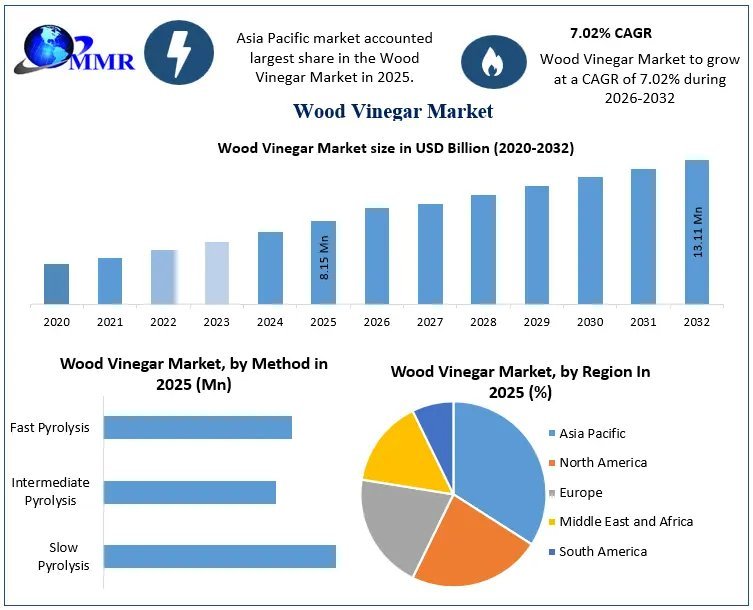
The Global Wood Vinegar Market was valued at USD 8.15 million in 2025 and is projected to reach approximately USD 13.11 million by 2032, growing at a compound annual growth rate (CAGR) of 7.02% during 2026–2032. Increasing interest in bio-based agricultural inputs, organic farming practices, and sustainable crop protection solutions is supporting the market’s expansion.
Wood vinegar, also known as pyroligneous acid, is produced by condensing smoke generated during the heating or pyrolysis of biomass. It contains organic compounds, including acetic acid, methanol, and phenolic substances. Depending on its composition and purification, wood vinegar can be used in agriculture, animal feed, food processing, and other applications.
Growing concerns about conventional agrochemicals, soil quality, and sustainable resource utilization are creating opportunities for wood vinegar producers. The use of agricultural and forestry residues as feedstock also supports circular-economy initiatives by converting biomass waste into commercially useful products.
Request Free Access to the Sample Report : https://www.maximizemarketresearch.com/request-sample/66938/
Market Transformation Through Bio-Based Solutions
The wood vinegar industry is benefiting from a shift toward agricultural products that support soil management, crop development, and reduced dependence on conventional chemical inputs. Farmers and agricultural businesses are exploring wood vinegar for applications such as composting, plant growth support, and pest management.
Organic agriculture is a major growth driver. As demand for organically produced food increases, agricultural producers are considering bio-based fertilizers, soil conditioners, and crop protection alternatives. Wood vinegar is attracting attention because it can be produced from biomass and incorporated into different agricultural practices, subject to suitable formulation and application requirements.
The market is also expanding beyond agriculture. Potential applications include animal feed, food and beverages, pharmaceuticals, and personal care and cosmetics. Different production methods and purification levels allow manufacturers to develop products for particular uses.
Despite these opportunities, the industry faces several challenges. Wood vinegar composition can vary according to feedstock, pyrolysis conditions, and purification processes. This variability can affect product consistency and application performance. In addition, dependence on charcoal and biomass production creates concerns about feedstock availability, forest-resource management, and environmental compliance.
Manufacturers must therefore focus on quality control, responsible sourcing, consistent production, and application-specific standards to strengthen commercial adoption.
Research Coverage and Forecasting Structure
The MMR report uses 2025 as the base year, with the forecast period extending from 2026 to 2032. Historical data covers 2020–2025. The study examines market value, production methods, application areas, regional demand, competitive positioning, and the factors influencing future industry growth.
The market is primarily segmented by:
- Method: Slow Pyrolysis, Intermediate Pyrolysis, and Fast Pyrolysis.
- Application: Agriculture, Animal Feed, Food & Beverages, Pharmaceuticals, Personal Care & Cosmetics, and Others.
- Region: North America, Europe, Asia Pacific, Middle East & Africa, and South America.
The research framework also considers market drivers, restraints, opportunities, competitive strategies, value-chain developments, and regional market conditions. MMR’s broader analytical coverage includes tools such as Porter’s Five Forces and PESTEL analysis to assess competitive pressure and external business factors.
Regional Performance and Emerging Growth Markets
Asia Pacific dominated the Wood Vinegar Market in 2025, according to MMR. Regional demand is supported by the importance of agriculture, growing interest in organic food, increasing adoption of bio-based agricultural products, and the presence of wood vinegar manufacturers.
India is an important market because agriculture plays a substantial role in its economy, creating opportunities for soil-enhancement products and alternative crop-management inputs. China, Japan, South Korea, Thailand, and other regional markets also contribute to the broader industry landscape.
North America offers opportunities through agricultural applications, biomass processing, and the development of bio-based products. The United States and Canada are among the countries included in the report’s regional assessment.
Get Instant Access to the Sample Report : https://www.maximizemarketresearch.com/request-sample/66938/
Europe represents another relevant market, with interest in sustainable agriculture, bio-based inputs, and resource-efficient production. Companies operating in the region can benefit from growing attention to environmental performance and agricultural sustainability.
The Middle East & Africa and South America are also covered in the report. Opportunities in these regions depend on agricultural requirements, biomass availability, production infrastructure, distribution networks, and the commercial suitability of wood vinegar products.
MMR identifies Asia Pacific as the leading region but does not provide a verified numerical market-share percentage in the published overview. Accordingly, no specific regional share is stated here.
Production Methods and Application-Based Market Structure
The Wood Vinegar Market is divided into production methods and application categories, each addressing different operational and commercial requirements.
Production Method Analysis
The Slow Pyrolysis segment dominated the market in 2025 and is expected to maintain its leading position during the forecast period. MMR attributes this position to its ability to produce substantial quantities of wood vinegar, comparatively lower temperature requirements, and suitability for handling varied biomass feedstocks.
Slow pyrolysis involves heating biomass under controlled conditions with limited oxygen, allowing the resulting vapors to be condensed into liquid products. The process can be suitable for producers seeking to recover useful by-products from biomass conversion.
Other methods include:
- Intermediate Pyrolysis: A production approach between slow and fast pyrolysis in terms of process conditions and vapor residence time.
- Fast Pyrolysis: A method characterized by rapid heating and short vapor residence times, generally requiring more intensive temperature control.
The choice of production method depends on desired product yield, feedstock characteristics, process design, and the intended application.
Application Analysis
The Agriculture segment dominated the market in 2025 and is expected to retain its leading position through 2032. Wood vinegar is used in agricultural formulations and practices associated with crop management, composting, soil conditioning, and plant development.
The other application segments include:
- Animal Feed: Wood vinegar-based products may be incorporated into selected feed-related applications, subject to appropriate formulation and safety requirements.
- Food & Beverages: Certain wood-derived condensates can be used in food-related applications where their composition and regulatory status permit.
- Pharmaceuticals: The segment covers potential uses of wood vinegar-derived substances in relevant product development.
- Personal Care & Cosmetics: Interest in wood vinegar-based ingredients creates opportunities for selected formulations.
- Others: Additional applications across industrial and specialized markets.
Product suitability differs significantly across these applications. Food, pharmaceutical, cosmetic, and feed-related uses require appropriate quality specifications and regulatory compliance; agricultural-grade material should not automatically be considered suitable for these purposes.
Competitive Environment and Company Strategies
The Wood Vinegar Market includes producers, biomass-processing businesses, agricultural-input suppliers, and companies developing bio-based products. Competitive positioning depends on product quality, production efficiency, feedstock access, distribution capabilities, application expertise, and the ability to serve specific customer requirements.
MMR identifies the following companies among the market participants:
North America
- B&G Foods, Inc.
- Red Arrow International LLC
- Baumer Foods, Inc.
- Canada Renewable Bioenergy Corp
- New Life Wood Vinegar
Europe
- Verdi Life
- Nettenergy
- Kerry Group PLC
- ETIA S.A.S.
- Fasera
Asia Pacific
- ACE Pte Ltd
- New Life Agro
- Doi & Co. Ltd
- Tagrow Co., Ltd.
- Sane Shell Carbon
- Thai Wood Vinegar
- Penta Manufacturer
- Nakashima Trading Co. Ltd.
- Taiko Pharmaceutical Co., Ltd.
- Applied Gaia Corporation
Middle East & Africa
- Green Life Company
- BioArabia
- AfriPyro (Pty) Ltd
- EcoGen Africa
- AgriBio Solutions
South America
- Biochar do Brasil
- Pirólise Brasil
- Ecofogão
- Carbono Sur
- AgroPyro
The report highlights ACE Pte Ltd and B&G Foods, Inc. among the notable participants in the competitive landscape. More broadly, companies can strengthen their market positions through sustainable biomass sourcing, consistent product specifications, agricultural partnerships, improved processing technologies, and expansion into additional applications.
Important Questions for Market Participants
- What was the global Wood Vinegar Market value in 2025?
The market was valued at USD 8.15 million in 2025.
- What is the projected market value by 2032?
The market is expected to reach approximately USD 13.11 million by 2032.
- What is the expected CAGR from 2026 to 2032?
The market is forecast to grow at a CAGR of 7.02%.
- Which region led the market in 2025?
Asia Pacific held the leading regional position.
- Which production method dominated the market?
Slow pyrolysis was the leading method in 2025.
Explore the Report Sample Before You Buy : https://www.maximizemarketresearch.com/request-sample/66938/
Report Deliverables and Strategic Industry Intelligence
The MMR report provides an assessment of the Wood Vinegar Market through 2032, combining market forecasts with production-method analysis, application segmentation, regional coverage, and competitive evaluation.
Its principal areas of coverage include:
- Global market size, historical performance, and revenue forecasts
- Forecast growth rate and outlook for 2026–2032
- Production-method analysis covering slow, intermediate, and fast pyrolysis
- Application analysis across agriculture, animal feed, food and beverages, pharmaceuticals, personal care and cosmetics, and other uses
- Regional assessment of North America, Europe, Asia Pacific, Middle East & Africa, and South America
- Country-level market coverage
- Competitive landscape and company profiling
- Market drivers, restraints, opportunities, and challenges
- Industry trends in organic agriculture and bio-based inputs
- Biomass feedstock utilization and circular-economy developments
- Production technology and product-quality considerations
- Value-chain and competitive-positioning assessment
- Porter’s Five Forces and PESTEL analysis
- Strategic insights for market participants and investors
View More Reports :
Global Low Alcohol Beverage Market https://www.maximizemarketresearch.com/market-report/low-alcohol-beverage-market/112935/
Reverse Osmosis Membrane Market https://www.maximizemarketresearch.com/market-report/reverse-osmosis-membrane-market/221749/
About Maximize Market Research
Maximize Market Research Pvt. Ltd. (MMR) is a global market research and consulting company that provides reliable, data-focused, and practical business insights. The firm serves a wide range of industries, including healthcare, pharmaceuticals, technology, automotive, electronics, chemicals, personal care, and consumer goods. Through market forecasts, competitive analysis, strategic consulting, and industry impact assessments, MMR helps organizations understand changing market conditions, identify growth opportunities, and make informed business decisions for long-term success.
Contact Us :
2nd Floor, Navale IT Park Phase 3
Pune Banglore Highway, Narhe
Pune, Maharashtra 411041, India
+91 9607365656
sales@maximizemarketresearch.com