Track Etched Membrane Market Overview
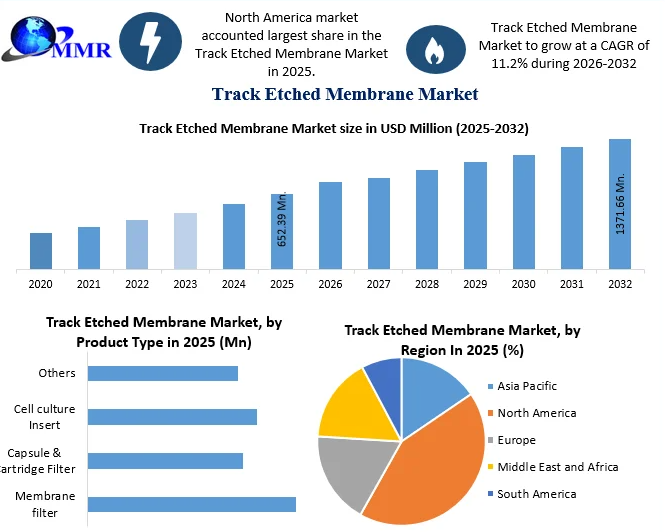
The global Track Etched Membrane Market was valued at USD 652.39 million in 2025 and is projected to reach nearly USD 1,371.66 million by 2032, growing at a compound annual growth rate (CAGR) of 11.2% during the forecast period from 2026 to 2032. The market is witnessing strong growth due to the increasing demand for high-precision filtration technologies across pharmaceutical manufacturing, biotechnology, medical diagnostics, environmental monitoring, food and beverage processing, and advanced research applications.
Feel free to request a complimentary sample copy or view a summary of the report: https://www.maximizemarketresearch.com/request-sample/16637/
Track-etched membranes (TEMs) are specialized filtration materials manufactured by exposing polymer films to energetic ions and subsequently using chemical etching to create uniform cylindrical pores. Unlike conventional membranes, these products offer highly controlled pore sizes, consistent pore distribution, and reliable particle separation. These characteristics make them suitable for applications requiring precise filtration, sample preparation, contamination control, and analytical accuracy.
Track Etched Membrane Market Drivers and Trends
Increasing Demand for High-Precision Filtration Solutions
The growing need for accurate and reproducible filtration is one of the major factors driving the Track Etched Membrane Market. Industries such as pharmaceuticals, biotechnology, food processing, and environmental testing require filtration products capable of separating particles according to specific size requirements while maintaining consistent performance.
Track-etched membranes provide uniform pore structures that enable controlled particle retention and predictable filtration characteristics. These properties are particularly valuable in analytical testing, cell biology, microbial monitoring, and sample preparation, where inconsistent filtration can affect test results and product quality.
The increasing focus on contamination control and compliance with quality standards is encouraging laboratories and industrial users to adopt precision-engineered filtration technologies. As research activities and quality assurance requirements expand, demand for membranes with reliable pore geometry and repeatable performance is expected to increase.
Expansion of Biomedical Research and Diagnostic Applications
The expansion of biomedical research and clinical diagnostics is another important growth driver. Track-etched membranes are used in cell culture inserts, cell migration studies, microfluidic devices, microscopy, and specialized sample preparation workflows.
Feel free to request a complimentary sample copy or view a summary of the report: https://www.maximizemarketresearch.com/request-sample/16637/
Their uniform pores and controlled surface characteristics make them suitable for applications requiring consistent cellular interaction and particle separation. In diagnostic laboratories, membrane filtration can support sample preparation and improve the removal of unwanted particles that may interfere with analytical procedures.
Increasing investments in personalized medicine, molecular diagnostics, vaccine development, and advanced biological research are creating additional demand for specialized membrane products. Research into regenerative medicine, tissue engineering, and three-dimensional cell culture is also generating opportunities for manufacturers that supply membranes and compatible laboratory accessories.
Growing Pharmaceutical and Biopharmaceutical Manufacturing
The expanding pharmaceutical and biopharmaceutical sectors are contributing to market development. The production of biologics, vaccines, and other complex therapeutic products requires carefully controlled manufacturing environments and reliable contamination management practices.
Track-etched membranes can support selected filtration, analytical testing, and process-monitoring applications in these industries. Their predictable pore structures make them useful in workflows where consistent particle separation and reproducible results are important.
The increasing adoption of single-use technologies and modular bioprocessing systems is creating opportunities for membrane suppliers to develop application-specific products, including customized formats and membrane assemblies. However, their suitability for sterile filtration or particular manufacturing steps depends on the membrane specification, validation requirements, and intended use.
Technological Advancements and Product Innovation
Continuous improvements in membrane materials, pore-size control, surface modification, and manufacturing processes are shaping the competitive landscape. Manufacturers are working to improve chemical compatibility, mechanical durability, flow characteristics, and product consistency to meet the requirements of specialized applications.
Innovations in membrane integration, including customized discs, sheets, inserts, cassettes, and filtration assemblies, are enabling suppliers to address more specific customer requirements. Improved manufacturing controls and product documentation are also important for laboratories and industrial users that require traceability and reproducibility.
The integration of track-etched membranes into microfluidic platforms, advanced diagnostic systems, and environmental monitoring equipment is expected to expand their potential applications over the forecast period.
Sustainability and Environmental Monitoring
Growing concerns regarding water quality, industrial pollution, and environmental safety are creating opportunities for precision membrane technologies. Track-etched membranes can be used in selected water analysis, particulate monitoring, and microbial sampling applications.
Their controlled pore sizes support standardized sample collection and analysis, helping environmental laboratories evaluate contamination levels in water and other samples.
Sustainability is also influencing product development, with manufacturers exploring material efficiency, waste reduction, and improvements in production processes. The development of recyclable or more environmentally compatible membrane materials may create additional opportunities, although their commercial adoption will depend on performance requirements, material compatibility, and lifecycle considerations.
High Production Costs and Scalability Challenges
Despite strong growth prospects, high production costs remain a significant challenge for the Track Etched Membrane Market. The manufacturing process requires specialized irradiation equipment, carefully controlled chemical etching, and precise quality inspection to achieve the required pore characteristics.
These requirements can increase capital expenditure, operating costs, and production complexity compared with some conventional filtration technologies. As a result, track-etched membranes may be less attractive for applications where low-cost filtration is sufficient.
Limited manufacturing capacity and the need for stringent quality controls can also constrain large-scale adoption. Manufacturers must balance product performance, production efficiency, and pricing to expand their presence in cost-sensitive industries and emerging markets.
Key Market Segments Covered
The Track Etched Membrane Market is segmented by material type, product type, pore size, application, end user, and region.
By Material Type
Based on material type, the market is categorized into polycarbonate, polyethylene terephthalate (PET), and polyimide.
Polycarbonate is expected to dominate the market over the forecast period due to its uniform pore structure, mechanical strength, optical clarity, and suitability for microscopy and laboratory research. These properties make polycarbonate membranes useful in cell biology, particle analysis, and specialized filtration applications.
PET membranes are gaining attention for applications that require durability and cost-effective performance, including environmental monitoring and water analysis. Polyimide membranes serve specialized applications where thermal and chemical resistance are important considerations.
By Product Type
The market is segmented into membrane filters, capsule and cartridge filters, cell culture inserts, and others.
Membrane filters held the largest market share in 2025, supported by their versatility and availability in different formats, including discs and sheets. They can be integrated into a broad range of laboratory procedures, particle analysis systems, and sample preparation workflows.
Capsule and cartridge formats offer opportunities in applications requiring convenient handling and integration into filtration assemblies. Cell culture inserts represent an important specialized segment, particularly for cell migration research, tissue engineering, toxicology studies, and advanced cell culture models.
By Pore Size
Based on pore size, the market includes less than 0.1 µm, 0.1–0.5 µm, 0.5–1.0 µm, 1.0–5.0 µm, and other pore sizes.
Demand varies according to the particle dimensions, filtration objectives, and analytical requirements of individual applications. Smaller pore sizes are relevant to specialized separation and analytical workflows, while larger pore sizes can support applications involving larger particles, cells, and particulate samples.
The selection of an appropriate membrane depends on the intended use, required retention characteristics, chemical compatibility, and operating conditions.
By Application
The market is divided into cell biology, micrology, analytical testing, and others.
Cell biology represents a significant application area because track-etched membranes are used in cell culture inserts, migration assays, and research involving cellular interactions. Analytical testing is another important segment, supported by the need for consistent sample preparation and particle separation.
Micrology-related applications, including selected microbial sampling and laboratory testing workflows, also contribute to demand. Additional opportunities exist in environmental monitoring, specialized industrial testing, and diagnostic technologies.
By End User
Based on end user, the market is segmented into pharmaceutical and biopharmaceutical companies, academic and research institutes, food and beverage companies, hospitals and diagnostic centers, and others.
Pharmaceutical and biopharmaceutical companies represent a key customer group because of their requirements for controlled filtration, quality testing, and research applications. Academic and research institutes contribute to demand through biological research, material science, and laboratory testing.
Hospitals and diagnostic centers use specialized membrane products in selected analytical and diagnostic workflows. Food and beverage companies and environmental testing organizations also provide opportunities for manufacturers offering application-specific filtration solutions.
Feel free to request a complimentary sample copy or view a summary of the report: https://www.maximizemarketresearch.com/request-sample/16637/
Track Etched Membrane Market Regional Analysis
North America
North America dominated the Track Etched Membrane Market in 2025. The region benefits from an established pharmaceutical industry, advanced biotechnology research, well-developed laboratory infrastructure, and significant investment in life sciences.
The presence of major companies, including Danaher Corporation, Cytiva, Thermo Fisher Scientific, and Corning Incorporated, supports product availability and technological development. Research institutions and diagnostic laboratories also contribute to demand for precision membrane products.
Regulatory expectations concerning pharmaceutical quality, laboratory procedures, and environmental testing encourage the adoption of reliable filtration and analytical technologies. Continued investment in biologics, advanced diagnostics, and biotechnology research is expected to support regional growth.
Europe
Europe represents an important market due to its strong pharmaceutical manufacturing base, established research institutions, and specialized membrane technology suppliers. Countries such as Germany, the United Kingdom, France, and Italy contribute to demand through biotechnology, laboratory research, environmental monitoring, and industrial testing.
Companies including Merck KGaA, Sartorius AG, GVS S.p.A., and MACHEREY-NAGEL serve a range of filtration and laboratory markets. Continued emphasis on research quality, manufacturing standards, and environmental monitoring is expected to support the regional market.
Asia Pacific
Asia Pacific is expected to offer significant growth opportunities during the forecast period. Increasing pharmaceutical manufacturing, expanding biotechnology capabilities, and investment in healthcare infrastructure are creating demand for advanced laboratory and filtration products.
China, India, Japan, and South Korea are important markets due to their pharmaceutical industries, research activities, and growing diagnostic capabilities. Improvements in laboratory infrastructure and greater attention to water quality and environmental monitoring are also expected to encourage adoption.
The region’s growth potential is supported by expanding research investments and the increasing availability of specialized laboratory equipment. However, pricing considerations and differences in technical infrastructure may influence the pace of adoption across individual countries.
Middle East and Africa and South America
The Middle East and Africa market is supported by investments in healthcare infrastructure, water treatment, environmental testing, and laboratory capabilities. Increasing attention to water quality and industrial monitoring may create opportunities for specialized filtration products.
South America is expected to benefit from developments in pharmaceutical production, food quality testing, environmental monitoring, and scientific research. Brazil and Argentina represent important markets within the region.
Across both regions, greater product availability, technical support, and investment in laboratory infrastructure could contribute to long-term market expansion.
Major Industry Players in the Track Etched Membrane Market
The competitive landscape is characterized by established membrane manufacturers, life sciences companies, laboratory equipment suppliers, and specialized filtration businesses. Competition is influenced by product consistency, pore-size accuracy, material selection, application-specific formats, distribution networks, and technical support.
Leading companies are focused on strengthening product portfolios, improving manufacturing quality, and providing membrane solutions that meet the requirements of research laboratories, pharmaceutical manufacturers, and industrial customers.
The availability of multiple membrane formats and customization capabilities can provide a competitive advantage. Customers often prioritize suppliers that offer reliable documentation, repeatable performance, and consistent product availability, particularly when changing membrane specifications requires additional testing or method validation.
Key Market Players
North America
- Cytiva
- Danaher Corporation
- Thermo Fisher Scientific
- Sterlitech Corporation
- Zefon International
- Corning Incorporated
- Graver Technologies
- Avanti Polar Lipids
- SKC Inc.
- Avestin
Europe
- Merck KGaA
- Sartorius AG
- BRAND GmbH
- SABEU GmbH & Co. KG
- MACHEREY-NAGEL GmbH & Co. KG
- Oxyphen AG
- GVS S.p.A.
- Greiner Bio-One
- CHMLAB
- Sarstedt
Asia Pacific
- ADVANTEC
- SKC Co., Ltd.
- QingFeng Filter
- Zhejiang Newstar
- Cytiva
- Merck
- Sartorius
- GVS
- Corning Incorporated
Competitive Strategies and Market Opportunities
Manufacturers are competing through product innovation, expanded distribution, application-specific customization, and improvements in manufacturing efficiency. Companies supplying membrane filters alongside compatible laboratory products and accessories can strengthen customer relationships and increase product adoption.
Customized membrane formats, specialized pore sizes, and integration into analytical equipment provide opportunities to address high-value applications. Suppliers that support customers with technical documentation and consistent product quality may also benefit from long-term purchasing relationships.
The market’s future competitive dynamics will depend on the ability of companies to deliver reliable membrane performance while managing production costs and expanding access to emerging markets.
Track Etched Membrane Market Key Trends
Three major trends are expected to influence the market between 2026 and 2032.
Integration into advanced life sciences applications: Increasing use in cell biology, microfluidics, microscopy, and specialized analytical procedures is creating demand for membranes with tightly controlled pore structures and consistent performance.
Expansion of bioprocessing and diagnostic technologies: Growth in biologics research, vaccine development, and diagnostic testing is supporting demand for specialized membrane products used in selected filtration and sample preparation workflows.
Sustainability and manufacturing efficiency: Greater attention to waste reduction, material utilization, and production efficiency is encouraging manufacturers to evaluate more sustainable manufacturing practices and alternative materials without compromising product performance.
These trends are expected to create opportunities for suppliers that combine technical precision, customization, and dependable product availability.
Track Etched Membrane Market Scope of the Report
| Report Parameter | Details |
|---|---|
| Base Year | 2025 |
| Forecast Period | 2026–2032 |
| Historical Data | 2020–2025 |
| Market Size in 2025 | USD 652.39 million |
| Forecast CAGR | 11.2% |
| Projected Market Size in 2032 | USD 1,371.66 million |
| Segments Covered | Material Type, Product Type, Pore Size, Application, End User, and Region |
| Major Regions | North America, Europe, Asia Pacific, Middle East and Africa, and South America |
Frequently Asked Questions (FAQs)
1. What was the global Track Etched Membrane Market size in 2025?
The global Track Etched Membrane Market was valued at USD 652.39 million in 2025.
2. What is the projected size of the Track Etched Membrane Market by 2032?
The market is expected to reach nearly USD 1,371.66 million by 2032, according to the stated market forecast.
3. What is the expected CAGR of the Track Etched Membrane Market during 2026–2032?
The market is projected to grow at a compound annual growth rate of 11.2% during the forecast period from 2026 to 2032.
4. What are track-etched membranes?
Track-etched membranes are precision-engineered filtration materials manufactured by irradiating polymer films and chemically etching the resulting tracks to create uniform pores. They are used in specialized filtration, particle separation, laboratory research, and analytical testing.
5. What are the major factors driving the Track Etched Membrane Market?
The principal growth drivers include increasing demand for high-precision filtration, expansion of pharmaceutical and biopharmaceutical manufacturing, growing biomedical research, advances in diagnostics, and increasing requirements for reliable environmental monitoring.
Conclusion
The global Track Etched Membrane Market is positioned for substantial growth as demand for precision filtration, advanced biomedical research, pharmaceutical quality control, and environmental monitoring continues to expand. With the market projected to increase from USD 652.39 million in 2025 to USD 1,371.66 million by 2032, manufacturers have opportunities to strengthen their market presence through technological innovation, application-specific product development, and improved production efficiency.
Connect With Us:
MAXIMIZE MARKET RESEARCH PVT. LTD.
2nd Floor, Navale IT park Phase 3,
Pune Banglore Highway, Narhe
Pune, Maharashtra 411041, India.
+91 9607365656
sales@maximizemarketresearch.com
About Maximize Market Research:
Maximize Market Research is one of the fastest-growing market research and business consulting firms serving clients globally. Our revenue impact and focused growth-driven research initiatives make us a proud partner of majority of the Fortune 500 companies. We have a diversified portfolio and serve a variety of industries such as IT & telecom, chemical, food & beverage, aerospace & defense, healthcare and others.