Revenue Growth Outlook for the Thermoplastic Pipe Industry
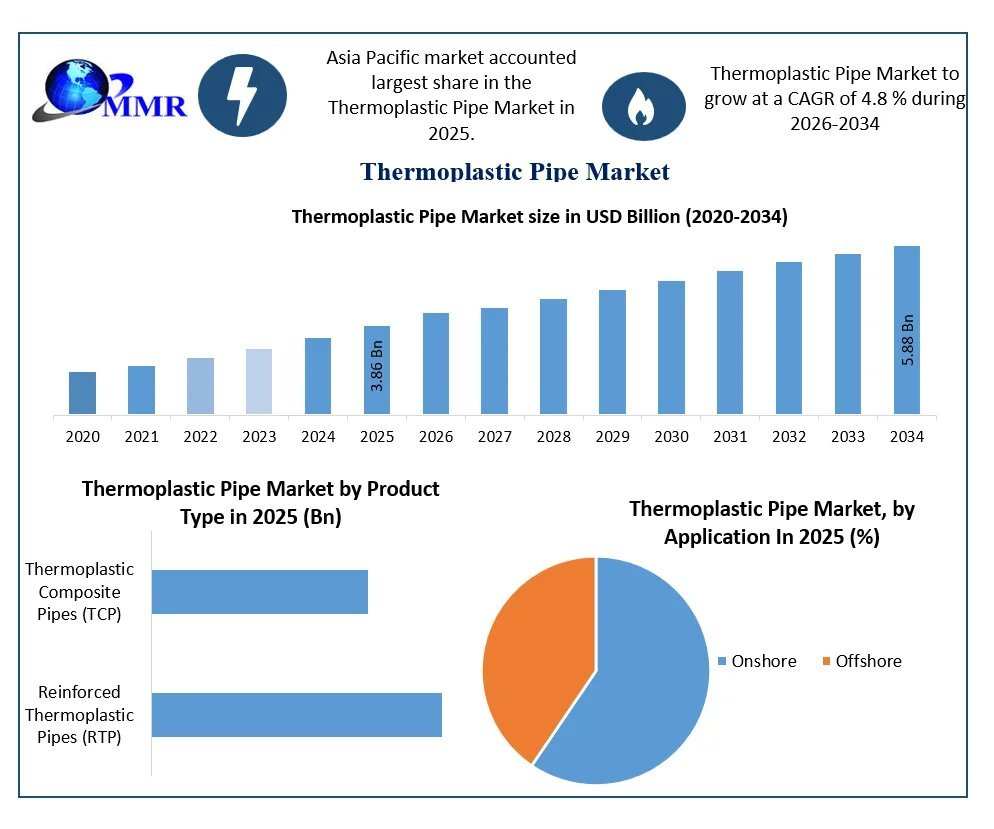
The Thermoplastic Pipe Market was valued at USD 3.86 billion in 2025 and is projected to reach nearly USD 5.88 billion by 2034, expanding at a compound annual growth rate (CAGR) of 4.8% during the forecast period from 2026 to 2034. Market expansion is supported by increasing demand for corrosion-resistant piping systems, infrastructure modernization, expanding gas distribution networks, and the growing use of lightweight materials across industrial applications.
Thermoplastic pipes are increasingly considered alternatives to conventional metallic pipelines because of their flexibility, relatively low weight, chemical resistance, and installation advantages. Their application across oil and gas operations, water and wastewater management, utilities, mining, and industrial infrastructure continues to create opportunities for manufacturers. Growing interest in reinforced thermoplastic pipes and advanced composite designs is also supporting the development of piping solutions for demanding operating environments.
Get Your Complimentary Report Preview : https://www.maximizemarketresearch.com/request-sample/31146/
Industry Landscape and Emerging Thermoplastic Piping Trends
Thermoplastic pipes are manufactured using polymer materials such as polyethylene (PE), polyvinyl chloride (PVC), polypropylene (PP), and other specialized plastics. These materials offer different combinations of flexibility, durability, chemical resistance, and pressure-handling capabilities, making them suitable for diverse applications.
A significant trend is the growing adoption of reinforced thermoplastic pipes (RTP) and thermoplastic composite pipes (TCP). These systems combine polymer-based materials with reinforcement technologies to improve mechanical performance in applications where conventional plastic piping may not meet operational requirements. Their use in oil and gas gathering, water injection, fluid transportation, and selected offshore operations is attracting industry attention.
Polyethylene pipes remain important in gas distribution and water infrastructure because they are lightweight, corrosion-resistant, and comparatively straightforward to install. Meanwhile, advances in composite construction and multilayer pipe designs are creating opportunities to address more demanding pressure and temperature requirements.
Principal Growth Drivers, Opportunities, and Market Constraints
Demand for thermoplastic pipes is being supported by infrastructure development, the modernization of water distribution systems, and the need for reliable gas transportation networks. Compared with conventional steel and iron piping, thermoplastic solutions can offer reduced corrosion-related maintenance and easier handling, depending on the application and operating conditions.
The oil and gas industry represents an important area of opportunity, particularly for reinforced and composite piping systems used in gathering lines, water injection, and other specialized operations. Demand for flexible, corrosion-resistant materials in challenging environments is encouraging manufacturers to develop products tailored to specific pressure, temperature, and fluid requirements. Infrastructure expansion and renewable-energy-related utility projects may also support additional applications.
However, high material and manufacturing costs remain significant restraints for advanced thermoplastic composites. High-performance polymers such as polyether ether ketone (PEEK) and polyphenylene sulfide (PPS) can be considerably more expensive than conventional piping materials. Product customization, specialized fabrication processes, and coordination between polymer suppliers and pipe manufacturers can further complicate large-scale production.
Performance limitations under particular operating conditions, the need for consistent manufacturing standards, and concerns about tensile, flexural, and torsional stresses also present challenges. Continued materials research, improved production processes, and application-specific engineering will be important to overcoming these barriers.
Explore the Report Sample Before You Buy : https://www.maximizemarketresearch.com/request-sample/31146/
Research Coverage and Analytical Methodology
The Thermoplastic Pipe Market report evaluates market development using historical information from 2020 to 2025, with 2025 serving as the base year and 2026–2034 representing the forecast period. The analysis covers market size, growth projections, regional performance, competitive positioning, and major industry segments.
The research framework includes segmentation by product type, polymer type, end-user industry, application, and geography. It also examines growth drivers, restraints, emerging opportunities, industry challenges, and the competitive environment. Analytical coverage includes competitive benchmarking, company profiles, and broader industry assessment through tools such as SWOT, PESTLE, and Porter’s Five Forces analysis.
This approach helps industry participants assess demand patterns, identify potential investment opportunities, and understand factors influencing market development.
Regional Demand Patterns and Market Opportunities
Asia-Pacific held the largest revenue share of the Thermoplastic Pipe Market in 2025 and is expected to maintain its leading position through the forecast period. The regional market is projected to grow at a CAGR of 4.6%. Urbanization, infrastructure development, and increasing investment in drinking-water and sewage networks are supporting demand for cost-effective piping systems.
China’s oilfield infrastructure has created applications for reinforced and other non-metallic composite pipes, particularly in oil and gas gathering, water injection, and wastewater-related operations. Growing demand for PVC and other plastic piping solutions in countries such as India and China also contributes to the region’s market potential.
North America is expected to experience substantial growth, supported by established pipeline infrastructure and the use of plastic piping in utility and specialized industrial applications. The United States and Canada offer opportunities across gas distribution, drainage, water infrastructure, and advanced composite piping. Europe, the Middle East and Africa, and South America also represent markets for thermoplastic piping across industrial, utility, and infrastructure applications, although individual growth rates and market shares vary.
Market Segmentation by Product, Polymer, Industry, and Application
The market is categorized across several dimensions to reflect the different requirements of thermoplastic piping users.
By Product Type: Reinforced Thermoplastic Pipes (RTP) and Thermoplastic Composite Pipes (TCP). RTP dominated the market in 2025, supported by demand for flexible, reinforced piping in oil and gas operations and other high-pressure applications.
By Polymer Type: Polyethylene (PE), Polypropylene (PP), Polyvinylidene Fluoride (PVDF), Polyvinyl Chloride (PVC), and others. Polyethylene held the largest market position in 2025 and is projected to grow at approximately 4.3% CAGR during the forecast period. Its flexibility, toughness, chemical resistance, and suitability for water and gas distribution support its widespread use.
By End-User Industry: Oil and Gas; Water and Wastewater; Mining and Dredging; and Utilities and Renewables.
By Application: Onshore and Offshore.
These segments allow manufacturers and investors to compare opportunities across material technologies, infrastructure requirements, and operating environments.
Request Free Access to the Sample Report : https://www.maximizemarketresearch.com/request-sample/31146/
Competitive Environment and Industry Participants
The Thermoplastic Pipe Market includes established piping manufacturers, polymer suppliers, and companies developing specialized composite solutions. Competition is shaped by product performance, manufacturing capabilities, pricing, technical expertise, regulatory compliance, and the ability to meet demanding end-user requirements.
Key companies identified in the report include Advanced Drainage Systems Inc., Chevron Phillips Chemical, National Oilwell Varco (NOV), Baker Hughes, ExxonMobil, Polyflow LLC, IPEX Inc., Shawcor, Magma Global, Prysmian Group, Georg Fischer Piping Systems, Uponor Corporation, AGRU Kunststofftechnik, Wienerberger, and Finolex Industries Ltd.
Industry developments illustrate continuing investment in production capabilities and advanced piping technologies. The report identifies NOV’s March 2025 agreement with Petrobras to develop flexible thermoplastic pipes for high-CO₂ deepwater applications, Advanced Drainage Systems’ May 2025 acquisition of River Valley Pipe LLC, and Strohm’s August 2025 contract for carbon-fiber PA12 thermoplastic composite pipe jumpers for an offshore Malaysian project.
These developments highlight the importance of innovation, strategic expansion, and specialized engineering in addressing evolving pipeline requirements.
Key Questions Addressed in the Thermoplastic Pipe Market Report
What was the market size in 2025? The market was valued at USD 3.86 billion.
What is the projected market size by 2034? Revenue is expected to reach nearly USD 5.88 billion.
What CAGR is forecast for 2026–2034? The market is projected to grow at 4.8%.
Which region led the market in 2025? Asia-Pacific held the largest regional revenue share.
Which product segment dominated in 2025? Reinforced thermoplastic pipes (RTP) held the leading position.
Which polymer type held the largest market position? Polyethylene (PE) was the leading polymer segment.
What are the major applications of thermoplastic pipes? Applications include oil and gas operations, water and wastewater systems, mining, utilities, and renewable-energy-related infrastructure.
What factors are driving market growth? Infrastructure expansion, gas distribution demand, corrosion resistance, and the advantages of lightweight piping systems are important contributors.
What challenges affect market expansion? High costs for advanced materials, manufacturing complexity, and application-specific performance requirements can restrict adoption.
Who are the major companies covered? The report profiles companies including Advanced Drainage Systems, NOV, Baker Hughes, IPEX, Shawcor, Magma Global, Prysmian Group, and Finolex Industries.
Future Prospects for Thermoplastic Pipe Technologies
The Thermoplastic Pipe Market is expected to maintain steady growth through 2034 as infrastructure investment, gas distribution requirements, and industrial demand support the adoption of polymer-based piping systems. Reinforced thermoplastic pipes and composite technologies may create further opportunities where corrosion resistance, flexibility, reduced installation complexity, and specialized performance are priorities.
At the same time, manufacturers will need to address material costs, production scalability, and reliability under demanding operating conditions. Continued improvements in polymer formulations, reinforcement methods, and product engineering could help expand the range of suitable applications.
With the market projected to reach nearly USD 5.88 billion by 2034, companies that combine reliable product performance with cost-effective manufacturing and application-specific solutions may be better positioned to respond to changing infrastructure and industrial needs.
View More Reports :
Bulk Food Ingredients Market https://www.maximizemarketresearch.com/market-report/bulk-food-ingredients-market/124758/
Ice Flaking Machine Market https://www.maximizemarketresearch.com/market-report/ice-flaking-machine-market/122940/
About Maximize Market Research
Maximize Market Research Pvt. Ltd. (MMR) is a global market research and consulting company that provides reliable, data-focused, and practical business insights. The firm serves a wide range of industries, including healthcare, pharmaceuticals, technology, automotive, electronics, chemicals, personal care, and consumer goods. Through market forecasts, competitive analysis, strategic consulting, and industry impact assessments, MMR helps organizations understand changing market conditions, identify growth opportunities, and make informed business decisions for long-term success.
Contact Us :
2nd Floor, Navale IT Park Phase 3
Pune Banglore Highway, Narhe
Pune, Maharashtra 411041, India
+91 9607365656
sales@maximizemarketresearch.com