Market Overview
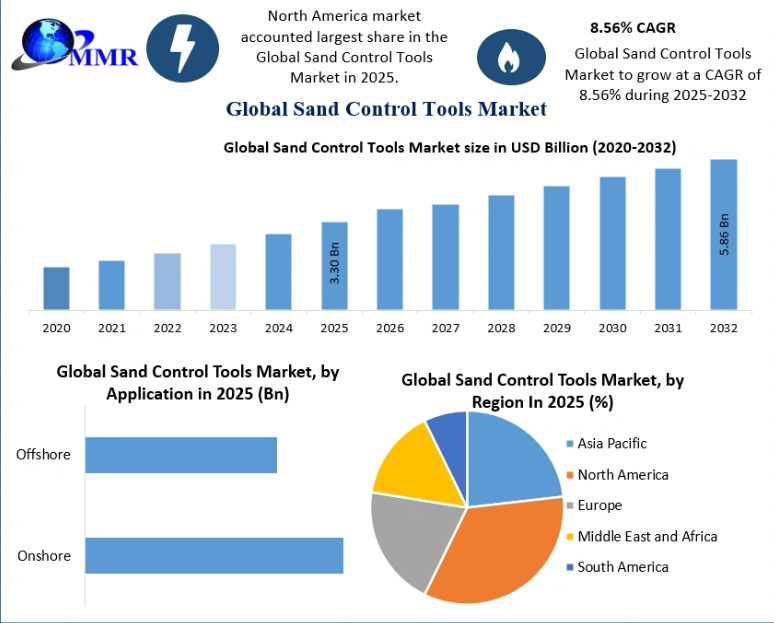
The Sand Control Tools Market is experiencing steady expansion as oil and gas operators increasingly focus on maintaining well productivity, protecting production equipment, and extending the operational life of mature and newly developed wells. The market was valued at approximately USD 3.30 billion in 2025 and is projected to reach nearly USD 5.86 billion by 2032, registering a CAGR of 8.56% from 2025 to 2032.
Dive deeper into market insights, trends, segmentation, and competitive landscape here: https://www.maximizemarketresearch.com/request-sample/147991/
Sand control refers to the techniques and equipment used to prevent or manage the production of formation sand during oil and gas extraction. Uncontrolled sand production can cause erosion, equipment damage, pipeline blockages, corrosion, reduced production efficiency, and unplanned maintenance. As operators move toward more complex reservoirs, deeper wells, and challenging offshore environments, the deployment of specialized sand control technologies is becoming increasingly important.
Sand control approaches can broadly be categorized into passive and active systems. Passive solutions are generally designed to control sand production without significant intervention, while active approaches involve more intrusive completion and well-management techniques. Technologies such as gravel pack tools, frac pack tools, sand screens, and inflow control devices (ICDs) are increasingly used to manage formation sand while maintaining desirable hydrocarbon flow rates.
The development of advanced completion technologies is also influencing the market. Inflow control devices, for example, are increasingly integrated with sand-screen technologies to balance reservoir inflow while controlling unwanted sand production. These solutions can support reservoir optimization, production stability, and improved well performance.
Market Drivers and Trends
Increasing Development of Mature Oilfields
The growing number of mature oil and gas fields is a significant factor supporting demand for sand control tools. As reservoirs mature, formation conditions can change and the risk of sand production may increase. Operators are therefore investing in completion and production technologies that can help maintain output while reducing equipment damage.
Sand control solutions can help operators manage sand-related production problems and support the continued operation of aging wells. This is particularly important in regions where operators are seeking to maximize recovery from established fields rather than relying exclusively on new discoveries.
Dive deeper into market insights, trends, segmentation, and competitive landscape here: https://www.maximizemarketresearch.com/request-sample/147991/
Technological Advancements in Well Completion
Technological development is transforming conventional approaches to sand management. Operators are increasingly adopting advanced screens, inflow control devices, intelligent completion technologies, and integrated sand-management solutions.
The integration of ICDs with sand screens represents an important development because it combines inflow management with sand control. Such technologies can help address complex reservoir conditions while reducing the operational challenges associated with conventional completion techniques.
Growth in Offshore Exploration and Production
Offshore exploration is another important growth factor. Oil and gas operators are increasingly developing shallow-water, deepwater, and ultra-deepwater resources. These environments can involve unconsolidated formations and complex geological conditions, increasing the importance of reliable sand management.
Offshore production infrastructure is also exposed to substantial operational and maintenance costs. Consequently, technologies capable of reducing sand-related equipment damage and production interruptions can have an important role in offshore well completion strategies.
Focus on Production Efficiency and Cost Optimization
Oil and gas companies continue to seek technologies that improve production efficiency while controlling operating expenses. Sand production can result in costly interventions, equipment replacement, and downtime. Effective sand control can help operators reduce these operational risks and support more consistent production.
The increasing use of engineered sand screens, gravel-pack systems, and advanced completion technologies reflects the industry’s broader focus on improving well economics.
Primary Market Constraints
Despite its growth potential, the Sand Control Tools Market faces several challenges. One of the most significant constraints is the volatility of crude oil and natural gas prices. When commodity prices decline, oil and gas companies may reduce capital expenditure, postpone drilling projects, or delay well-completion activities. Such decisions can directly affect demand for sand control equipment.
The capital-intensive nature of certain sand control techniques is another challenge. Traditional gravel-pack operations can require specialized equipment, additional completion activities, and considerable investment. These factors can make some solutions less attractive for operators operating under tight budgets.
Complex reservoir conditions can also increase installation and maintenance costs. High-pressure and high-temperature wells require equipment capable of performing reliably under demanding conditions. Corrosion, erosion, wax accumulation, and hydrate formation can further complicate sand management operations.
The oil and gas industry’s exposure to broader economic disruptions can also affect market development. Supply-chain interruptions, project delays, regulatory requirements, and fluctuations in exploration budgets can influence the timing of sand control system deployment.
Key Market Segments
By Tool Type
The market is segmented into Gravel Pack Tool, Frac Pack Tool, Sand Screens, and Inflow Control Sources.
Gravel pack tools represent one of the established approaches to sand control. Gravel packing involves placing appropriately sized gravel around the well screen to restrict the movement of formation sand while allowing hydrocarbons to flow. The technology has been used extensively in different well-completion environments.
Frac pack tools combine hydraulic fracturing and gravel packing techniques. The approach can improve reservoir connectivity while providing sand control and is particularly relevant for formations where conventional completion approaches may not provide sufficient productivity.
Sand screens provide mechanical filtration and are selected according to formation characteristics and particle-size distribution. Screen technology continues to evolve as operators seek improved reliability and compatibility with increasingly complex well designs.
Inflow control devices are also gaining attention because they can regulate fluid inflow and contribute to sand-management strategies. Their integration with other completion technologies creates opportunities for more sophisticated reservoir-management solutions.
By Application
The market is divided into Onshore and Offshore applications.
The offshore segment is expected to maintain strong demand as exploration and production move toward deeper and more technically challenging environments. Offshore formations can contain loosely consolidated sands that may enter production systems and cause erosion, blockages, and equipment damage.
Onshore applications remain important due to the extensive number of producing wells and mature oilfields worldwide. Operators in onshore environments continue to use sand management technologies to maintain well productivity and minimize production-related problems.
By Well Type
Based on well type, the market is categorized into Cased Hole and Open Hole applications.
Cased-hole completions provide a controlled wellbore environment and can accommodate various sand control technologies depending on reservoir and production requirements. Open-hole completions, meanwhile, can be particularly challenging because formation exposure requires carefully engineered sand-management solutions.
The selection of a sand control method depends on reservoir properties, formation strength, production targets, well geometry, pressure and temperature conditions, and the expected level of sand production.
Dive deeper into market insights, trends, segmentation, and competitive landscape here: https://www.maximizemarketresearch.com/request-sample/147991/
Regional Insights
North America held a dominant position in the Sand Control Tools Market in 2025. The region benefits from extensive oil and gas production activities, established drilling infrastructure, technological capabilities, and continued development of unconventional and mature resources. The presence of major oilfield service companies also supports innovation and deployment of advanced completion technologies.
The Middle East & Africa region represents an important growth market. Large hydrocarbon reserves, extensive oil and gas production, and increasing development of challenging reservoirs are supporting demand for sand-management technologies. Countries such as Saudi Arabia and Nigeria have significant oil and gas operations where formation characteristics and production conditions can create a need for effective sand control.
In the Asia Pacific, countries including Malaysia, Indonesia, Australia, China, and India are contributing to demand through continued exploration, production, and development of oil and gas resources. Offshore projects in particular can create opportunities for specialized sand control solutions.
Europe remains an important market because of its established hydrocarbon industry and offshore production capabilities. Norway and the United Kingdom continue to maintain significant offshore oil and gas activities, while other European markets are focused on maximizing output from existing assets.
South America, particularly Brazil, also offers opportunities due to offshore exploration and deepwater production. The increasing complexity of offshore reservoirs is expected to support demand for technologies capable of controlling sand while maintaining production efficiency.
Major Industry Players
The Sand Control Tools Market includes established oilfield service companies and specialized technology providers competing through product development, technological innovation, strategic partnerships, and expansion of regional operations.
Key companies identified in the market include:
- Schlumberger
- Weatherford
- Halliburton
- National Oilwell Varco
- Baker Hughes
- Dialog
- Interwell
- Mitchell
- Packers Plus
- Oil States International
- Superior Energy
- Tendeka
- Variprem
- Welltec
- Hebei Shengkai
- Sazoil
- Super Energy Service
- Anton Oilfield Services
These companies participate in areas including sand screens, gravel-pack solutions, completion systems, inflow control technologies, and related well-intervention services. Competition is influenced by technological capabilities, product reliability, geographic presence, project execution expertise, and the ability to provide solutions for high-pressure, high-temperature, offshore, and complex reservoir conditions.
Frequently Asked Questions
1. What was the Sand Control Tools Market size in 2025?
The Sand Control Tools Market was valued at approximately USD 3.30 billion in 2025.
2. What is the expected Sand Control Tools Market size by 2032?
The market is projected to reach approximately USD 5.86 billion by 2032.
3. What is the expected CAGR of the Sand Control Tools Market?
The Sand Control Tools Market is expected to grow at a CAGR of 8.56% from 2025 to 2032.
4. What are the major segments covered in the market?
The market is segmented by Tool Type, Application, and Well Type. Tool Type includes Gravel Pack Tool, Frac Pack Tool, Sand Screens, and Inflow Control Sources. Application includes Onshore and Offshore, while Well Type includes Cased Hole and Open Hole.
5. Which application segment is expected to experience strong demand?
The offshore segment is expected to witness significant demand due to increasing offshore exploration and production activities and the technical challenges associated with deepwater and ultra-deepwater wells.
Conclusion
The global Sand Control Tools Market is positioned for sustained expansion as oil and gas producers increasingly prioritize well integrity, production efficiency, reservoir optimization, and equipment protection. From USD 3.30 billion in 2025, the market is projected to reach USD 5.86 billion by 2032, reflecting an 8.56% CAGR during the forecast period.
Connect With Us:
MAXIMIZE MARKET RESEARCH PVT. LTD.
2nd Floor, Navale IT park Phase 3,
Pune Banglore Highway, Narhe
Pune, Maharashtra 411041, India.
+91 9607365656
sales@maximizemarketresearch.com
About Maximize Market Research:
Maximize Market Research is one of the fastest-growing market research and business consulting firms serving clients globally. Our revenue impact and focused growth-driven research initiatives make us a proud partner of majority of the Fortune 500 companies. We have a diversified portfolio and serve a variety of industries such as IT & telecom, chemical, food & beverage, aerospace & defense, healthcare and others.