Anticipated Growth in Revenue
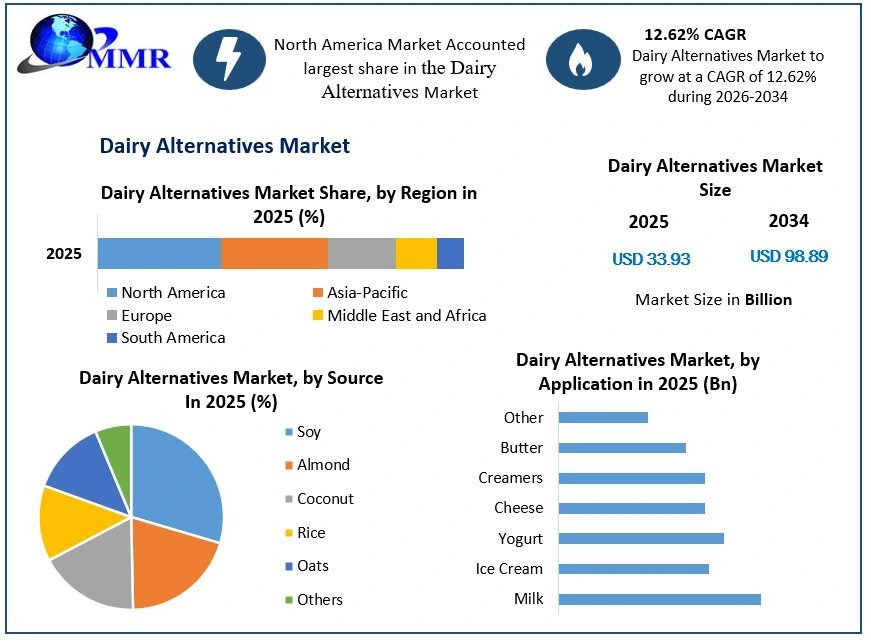
The Dairy Alternatives Market was valued at USD 33.93 billion in 2025 and is expected to grow at a CAGR of 12.62% from 2026 to 2034, reaching nearly USD 98.89 billion by 2034. Increasing consumer preference for plant-based foods, rising awareness of lactose intolerance, and growing demand for sustainable food products are supporting market expansion.
Market Overview
The Dairy Alternatives Market includes plant-based food and beverage products developed as substitutes for conventional dairy products. These alternatives are manufactured using ingredients such as soy, almonds, coconut, rice, oats, and other plant-based sources. Common products include plant-based milk, yogurt, cheese, ice cream, butter, and creamers.
The market is experiencing significant growth due to changing dietary preferences, increasing vegan and flexitarian populations, and rising awareness of health and environmental concerns associated with conventional dairy production. Consumers are increasingly choosing dairy-free products to manage lactose intolerance, milk allergies, and specific dietary requirements.
Explore the Report Sample Before You Buy : https://www.maximizemarketresearch.com/request-sample/25430/
Plant-based milk remains a major product category, with soy, almond, oat, and coconut milk widely consumed across global markets. Oat milk is gaining attention because of its creamy texture and suitability for coffee, beverages, breakfast products, and foodservice applications. Manufacturers are also introducing alternatives made from cashews, hazelnuts, flaxseeds, and other emerging plant-based ingredients.
Product innovation is playing an important role in market development. Companies are introducing fortified dairy alternatives containing calcium, vitamin D, vitamin B12, and plant-based proteins to improve nutritional value. Improvements in taste, texture, packaging, and product shelf life are helping manufacturers attract consumers who previously preferred conventional dairy products.
The increasing availability of dairy alternatives through supermarkets, hypermarkets, convenience stores, and online retail platforms is further supporting market penetration. E-commerce channels are providing consumers with access to a wider variety of plant-based brands and specialty products.
However, the industry faces challenges associated with production costs, raw-material price fluctuations, nutritional differences, and consumer concerns regarding taste and texture. Manufacturers are focusing on ingredient innovation, nutritional fortification, and sustainable sourcing to address these challenges.
Scope and Methodology
The Dairy Alternatives Market report provides a comprehensive assessment of market size, industry developments, competitive dynamics, regional performance, and future growth opportunities through 2034.
The study evaluates the market based on source, application, distribution channel, and region. It examines historical market performance, current consumer preferences, product innovation, supply-chain developments, and emerging opportunities across the global food and beverage industry.
The research methodology incorporates primary and secondary research to evaluate market conditions and estimate industry revenue. Primary research involves insights from industry participants, manufacturers, suppliers, and other relevant stakeholders. Secondary research includes company publications, industry reports, market databases, trade information, and relevant economic studies.
The report also uses analytical frameworks such as PORTER’s Five Forces, PESTEL analysis, SWOT analysis, value-chain analysis, and competitive benchmarking to assess industry competition, market risks, business opportunities, and strategic positioning.
The study further evaluates market drivers, restraints, opportunities, challenges, regulatory developments, and technological advancements influencing the global dairy alternatives industry.
Regional Insights
Asia Pacific
Asia Pacific represents a leading region in the global Dairy Alternatives Market. India, China, Japan, and South Korea are important contributors, supported by changing food preferences, growing health awareness, and increasing demand for plant-based protein products.
India represents a particularly significant market because of its established vegetarian food culture, expanding consumer base, and increasing interest in plant-based nutrition. Rising disposable incomes and the availability of dairy-free beverages and food products are creating opportunities for manufacturers.
China, Japan, and South Korea are also witnessing demand for soy-based beverages, plant-based milk, and other dairy-free products. Expanding retail networks and foodservice applications are supporting regional market development.
North America
North America represents an important market for dairy alternatives, supported by growing vegan and flexitarian populations, increasing lactose intolerance awareness, and demand for convenient plant-based food products.
The United States is a major contributor to regional revenue. Almond milk, oat milk, soy milk, plant-based yogurt, and dairy-free cheese are gaining consumer attention. Established food manufacturers and emerging plant-based brands are expanding their product portfolios to meet changing preferences.
Growing demand for sustainable food products and improvements in plant-based formulations are expected to create additional opportunities across the region.
Europe
Europe is supported by increasing consumer interest in vegan diets, environmental sustainability, and animal welfare. Countries such as Germany, the United Kingdom, France, Sweden, Italy, and Spain are important markets for dairy-free beverages and food products.
Manufacturers are focusing on innovative formulations, clean-label ingredients, fortified products, and sustainable packaging to strengthen their presence in the European market.
Middle East & Africa
The Middle East & Africa market is developing through increasing urbanization, changing dietary habits, expanding retail infrastructure, and rising awareness of plant-based nutrition.
South Africa and GCC countries represent important markets for dairy alternatives. Growing availability of plant-based beverages and increasing demand for convenient packaged food products are supporting market opportunities.
Request Free Access to the Sample Report : https://www.maximizemarketresearch.com/request-sample/25430/
South America
South America is witnessing gradual growth in dairy alternatives due to increasing consumer awareness of plant-based diets and expanding availability of dairy-free food and beverage products.
Brazil and Argentina are important markets, with opportunities emerging across plant-based milk, yogurt, cheese, and other dairy-free product categories.
Market Segmentation
By Source
- Soy
- Almond
- Coconut
- Rice
- Oats
- Others
The Soy segment held the largest market share of more than 40% in 2025 and is expected to grow at a CAGR of 9.42% during the forecast period. Soy-based products benefit from their protein content, established consumer acceptance, and widespread use in plant-based beverages and food applications.
Almond and oat-based alternatives are also gaining popularity because of their taste, texture, and expanding availability. Other emerging sources, including cashew, hazelnut, quinoa, and flax, are providing manufacturers with opportunities to introduce differentiated products.
By Application
- Milk
- Ice Cream
- Yogurt
- Cheese
- Creamers
- Butter
- Other
Milk represents a major application segment because of its widespread use in household consumption, beverages, breakfast products, and food preparation.
Plant-based ice cream, yogurt, and cheese are also gaining attention as manufacturers improve product formulations and introduce new flavors and textures. Dairy-free creamers are benefiting from increasing demand in coffee shops, restaurants, and household beverage applications.
By Distribution Channel
- Supermarket & Hypermarkets
- Convenience Stores
- Online Retail
- Others
Supermarkets and hypermarkets represent an important distribution channel because they provide consumers with access to different dairy alternative brands and product categories.
The online retail segment is expected to offer significant growth opportunities through 2034. Increasing e-commerce penetration, convenient purchasing, product variety, and home delivery services are supporting the expansion of online sales.
By Region
- North America
- United States
- Canada
- Mexico
- Europe
- United Kingdom
- France
- Germany
- Italy
- Spain
- Sweden
- Austria
- Rest of Europe
- Asia Pacific
- China
- South Korea
- Japan
- India
- Australia
- ASEAN
- Rest of APAC
- Middle East & Africa
- South Africa
- GCC
- Rest of ME&A
- South America
- Brazil
- Argentina
- Rest of South America
Key Players
The global Dairy Alternatives Market includes established food and beverage manufacturers and specialized plant-based product companies. Market participants are focusing on product innovation, geographical expansion, strategic partnerships, acquisitions, and improved distribution networks to strengthen their competitive positions.
North America
- Danone North America Public Benefit Corporation
- Elmhurst Milked Direct LLC
- The Hain Celestial Group, Inc.
- Blue Diamond Growers
- Eden Foods, Inc.
- Hiland Dairy
- Ripple Foods
- Kite Hill
- Califia Farms, LLC
- Miyoko’s Creamery
- Daiya Foods Inc.
- Earth’s Own Food Company Inc.
- SunOpta
Europe
- Vly
- Valsoia S.p.A.
- Qatly Group AB
- Triballat Noyal
- Nutriops, S.L.
- Nestlé S.A.
Asia Pacific
- PureHarvest
- One Good
- Freedom Foods Group Limited
- Sanitarium
- Green Spot Co., Ltd.
- Coconut Palm Group Co. Ltd.
- Hebei Yangyuan Zhihui Beverage Co. Ltd.
- Kikkoman Corporation
- Vitasoy International Holdings Ltd.
Key Questions Answered
- What was the global Dairy Alternatives Market size in 2025?
- What will be the market size by 2034?
- What CAGR is expected during the forecast period 2026–2034?
- What are the major factors driving the growth of the Dairy Alternatives Market?
- What are the key challenges and restraints affecting market expansion?
- Which source segment held the largest market share in 2025?
View More Reports :
Global Biodegradable Bone Graft Polymers Market https://www.maximizemarketresearch.com/market-report/global-biodegradable-bone-graft-polymers-market/71083/
Global Gypsum Ceiling Tiles Market https://www.maximizemarketresearch.com/market-report/global-gypsum-ceiling-tiles-market/71376/
About Maximize Market Research
Maximize Market Research Pvt. Ltd. (MMR) is a global market research and consulting company that provides reliable, data-focused, and practical business insights. The firm serves a wide range of industries, including healthcare, pharmaceuticals, technology, automotive, electronics, chemicals, personal care, and consumer goods. Through market forecasts, competitive analysis, strategic consulting, and industry impact assessments, MMR helps organizations understand changing market conditions, identify growth opportunities, and make informed business decisions for long-term success.
Contact Us :
2nd Floor, Navale IT Park Phase 3
Pune Banglore Highway, Narhe
Pune, Maharashtra 411041, India
+91 9607365656
sales@maximizemarketresearch.com